
Santander and Visa Complete Latin America's First Live Agentic Payment Transactions

Akihiro Suzuki
Twitter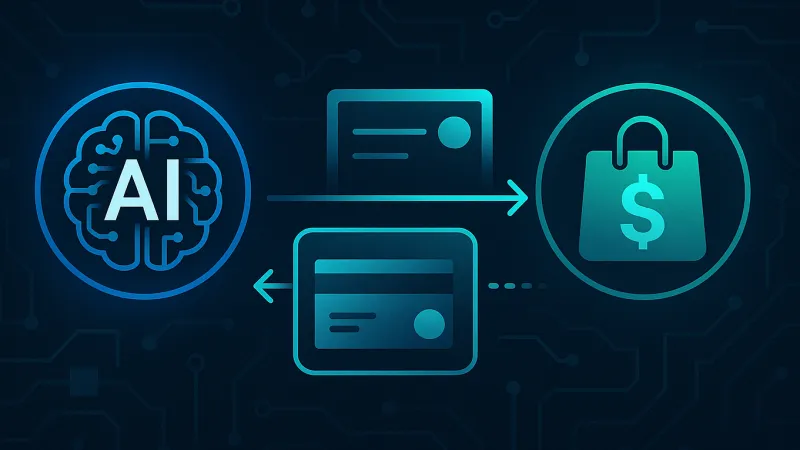
Source: www.finextra.com
Key Takeaways
- Santander leverages Visa Intelligent Commerce to conduct first live AI agent-powered transactions across five Latin American countries
- Following Europe, Latin America advances real-world deployment, making agentic payment commercialization realistic by 2026
- E-commerce businesses need to start preparing now for AI agent-driven purchase flows
Santander Achieves First AI Agent Payments in Latin America

Santander tests agentic payments across Latin America
Banco Santander is doubling down on its exploration of agentic payments, conducting its first live transactions with Visa in multiple Latin American markets.
On March 12, 2026, Banco Santander and Visa jointly announced the completion of Latin America's first live agentic payment transactions. The pilot covered five markets: Argentina, Brazil, Chile, Mexico, and Uruguay.
"Agentic payments" refers to a system where AI agents autonomously execute the entire process from product discovery to payment on behalf of consumers. In this pilot, AI agents successfully purchased books in Argentina, Chile, Mexico, and Uruguay, and chocolate in Brazil.
Matías Sánchez, Global Head of Cards and Digital Solutions at Santander, stated: "By testing actual transactions, we have demonstrated the viability of the technology to deliver safe and interoperable agentic commerce."
Background and Industry Context
Santander's agentic payment efforts are accelerating rapidly. Just two weeks earlier on March 2, it completed Europe's first end-to-end AI agent payment with Mastercard. Europe used Mastercard Agent Pay processing, while Latin America utilized Visa Intelligent Commerce. This means Santander is simultaneously advancing agentic payment pilots across both major payment networks.
This is not a Santander-only initiative but an industry-wide trend. In February, Singapore's DBS Bank conducted the first Asia-Pacific pilot of Visa Intelligent Commerce, while New Zealand's Westpac ran a movie ticket purchase proof-of-concept with Mastercard. On March 10, JP Morgan Payments partnered with Mirakl to build agentic commerce infrastructure.
Santander announced in 2025 that AI investments would generate €1 billion in business value over the next two years, positioning agentic payments as a core strategy.
How Visa Intelligent Commerce Works
The pilot utilized "Visa Intelligent Commerce (VIC)," a technology platform that leverages Visa's secure infrastructure to enable safe, transparent, "consent-based" transactions by AI agents.
Key VIC capabilities include:
- Consent Capture: Clearly defines and records the scope of authority consumers delegate to AI agents
- Secure Data Processing: Payment information is encrypted on Visa's infrastructure, with AI agents never directly holding card data
- Interoperability: Enables seamless transaction completion across different merchants and payment networks
The pilot was conducted within Santander and Visa's regulated payment framework, complying with existing supervisory standards. Catalina Tobar, Visa's Growth Products & Partnerships Lead for Latin America and the Caribbean, commented: "The pilot with Santander is a turning point for commerce in Latin America."
Visa is currently advancing VIC-related projects with over 100 partners worldwide, with over 30 developing in sandboxes and over 20 agents pursuing direct integrations.
Impact and Practical Implications for E-Commerce Businesses
According to Visa's research, over 70% of Latin American consumers already use AI for shopping. Similar figures apply in the Asia-Pacific region, with 80% of Singapore consumers using AI assistants for online shopping according to available data.
Three key points for e-commerce businesses to focus on:
AI-ready product catalogs are urgent. As the JP Morgan Payments and Mirakl partnership demonstrates, structured product data is essential for AI agents to "discover" products. Mirakl's Mirakl Nexus provides a foundation for optimizing product catalogs into AI agent-readable formats.
Payment flow redesign is necessary. Agentic payments complete transactions without traditional checkout screens. Merchants need technical capabilities to identify and properly process transaction requests from AI agents.
Security and governance become differentiators. As JP Morgan Payments' Mike Lozanoff points out, the differentiator in agentic commerce is not "AI" itself but "governance" — identity, consent, constraints, and interoperability. Adapting to trust frameworks like Visa's Trusted Agent Protocol, introduced in October 2025, becomes essential.
Summary
Santander's series of moves clearly demonstrates that agentic payments are transitioning from "experimental" to "practical" stages. Completing pilots across both major payment networks — Mastercard in Europe and Visa in Latin America — within a short timeframe evidences significant technical readiness on the banking side.
Visa predicts that millions of consumers will make purchases through AI agents by the 2026 holiday season. For e-commerce businesses, structuring product data and preparing AI agent payment flows is no longer a future concern — it's a practical task that should begin this quarter.
Related Articles

Santander and Mastercard Complete Europe's First AI Agent Payment -- Fully Autonomous Transactions Become Reality in Regulated Banking
Santander and Mastercard complete Europe's first end-to-end AI agent payment using Mastercard Agent Pay, achieving practical implementation in a regulated environment.

Visa and Mastercard's Battle for Agentic Commerce Standards Heats Up
Visa, Mastercard, and Stripe release competing agentic payment standards in the same week. Mastercard open-sources cryptographic Verifiable Intent with Google, while Visa scales its Intelligent Commerce ecosystem.

What is Agentic Payment? AI-Powered Next-Gen Automated Payments
[2-Minute Read] Learn about Agentic Payment, where AI agents autonomously handle payments. Discover the mechanisms, key players like Visa, Mastercard, and Stripe, and implementation strategies for automated payment systems.
Tags
Share this article