
96% of E-Commerce Retailers Have Invested in AI as Agentic Commerce Spending Accelerates

Akihiro Suzuki
Twitter
Source: www.customerexperiencedive.com
Key Takeaways
- LogicBroker's survey of 600+ enterprise e-commerce companies reveals 47% plan to invest over $1M in agentic commerce within 12 months
- AI-powered product discovery, chatbots, and personalization lead investment priorities, but ROI uncertainty and AI-to-human handoff challenges emerge
- E-commerce retailers should take a phased approach to AI adoption, balancing backend optimization with frontend experience improvements
Majority of E-Commerce Companies Move to Serious Agentic Commerce Investment

E-commerce retailers plan hefty investments in agentic commerce, study finds | CX Dive
Top applications include AI-powered product discovery, AI chatbots and personalized recommendations.
On March 16, 2026, customer experience media outlet CX Dive reported the results of a large-scale survey conducted by commerce platform company LogicBroker. According to the "The State of Agentic Commerce Adoption" report, which surveyed over 600 enterprise e-commerce businesses, nearly 96% of respondents have already invested in some form of AI capability, and 47% plan to invest over $1 million in agentic commerce within the next 12 months. Furthermore, 21% of those anticipate investments exceeding $5 million.
Industry Trends
Agentic commerce is a new form of commerce where AI agents autonomously execute everything from product search, comparison, and recommendation to purchase. While AI has primarily been used for backend operational efficiency, its application is now rapidly expanding to customer-facing touchpoints.
LogicBroker CEO Omar Qari stated in a BusinessWire press release that "the conversation around AI has been focused on 'discovery' such as search and recommendations, but what the data shows is that AI is penetrating deep into transactions themselves." His view is that when software agents begin deciding what to buy and where to source it, the very structure of digital commerce will change.
The market is expanding rapidly. According to a sanbi.ai market report, the agentic commerce market is expected to grow from $547 million at the end of 2025 to $5.2 billion within the next few years. McKinsey projects up to $5 trillion in global agentic commerce transaction volume by 2030.
AI Product Discovery and Chatbots Lead Investment, but Challenges Remain
According to LogicBroker's survey, the top AI investment areas for e-commerce retailers are AI-powered product discovery, AI chatbots, and personalized recommendations. All three are frontend, customer-facing functions, indicating that e-commerce businesses prioritize improving customer experience above all else.
Meanwhile, backend investment is also progressing. 44% are investing in price optimization and 43% in automated inventory management. Julie Geller of Info-Tech Research Group analyzed in an interview with CX Dive that "pricing optimization and demand forecasting work well because variables can be quantified, feedback is immediate, and if the model gets it wrong, it doesn't directly impact the customer relationship."
However, challenges remain with customer-facing AI chatbots. According to related CX Dive reporting, AI chatbots consistently fail at handling complex inquiries, and a survey commissioned by Pegasystems to YouGov found that two-thirds of consumers prefer interacting with humans.
Geller warns on this point: "Many AI agents sit in a no-man's-land between being human and being machine. Responses can be hollow, nonsensical, or poorly timed, and that hurts the brand." She further notes that "when a customer connects to a human agent after interacting with AI, the burden of explaining the situation should not fall on the customer. The handoff must be transparent, but that's rarely the case today."
ROI Expectations vs. Cost Reality
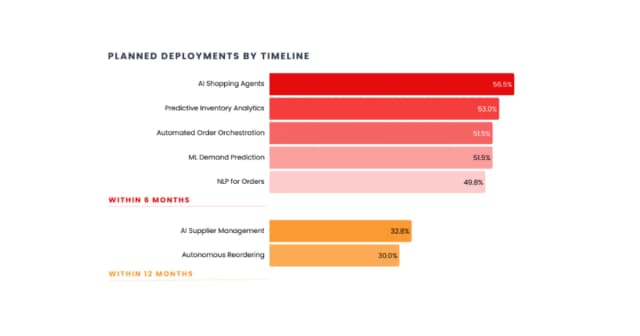
Return on investment expectations are high. LogicBroker's survey found that three-quarters of companies expect ROI within 24 months, and nearly half expect returns within one year. Additionally, more than half of companies plan to deploy AI shopping agents within the next six months.
However, caution is needed on the cost side. Gartner's January 2026 forecast projects that the per-resolution cost of generative AI customer service will exceed $3 by 2030, surpassing many offshore human agents. Rising data center costs, AI vendor pricing strategy shifts, and increased token consumption from complex use cases are the primary drivers.
In other words, positioning AI solely as a "cost-cutting tool" risks facing a gap between expectations and reality.
Impact on E-Commerce Businesses and Practical Applications
The survey results send a clear signal to e-commerce retailers. Agentic commerce has moved beyond the experimental stage and into a full-scale investment phase. However, a phased approach is essential for success.
Starting with the backend is an effective strategy. Areas like price optimization and inventory management have clearly defined variables and limited risk, making them accessible starting points for validating ROI. When deploying customer-facing AI chatbots, designing smooth handoffs to human operators will be the determining factor for success or failure.
For product discovery, AI applications based on behavioral signals rather than just search keywords show promise. As Geller states, "a customer who views the same product three times without purchasing is communicating something. AI can read that more accurately than keyword logic."
Furthermore, LogicBroker's survey revealed that hybrid B2B and B2C model companies account for 45% of the market, indicating that agentic commerce holds significant potential not just for B2C retail but also for streamlining B2B transactions.
Summary
The reality that 96% of e-commerce retailers have already invested in AI demonstrates that AI adoption is becoming a "table stakes" requirement rather than a competitive advantage. With 47% planning to invest over $1 million within the next 12 months, investment across the industry continues to accelerate.
However, given Gartner's warnings about ROI uncertainty and the fact that consumers still prefer human interaction, a simplistic "cut costs with AI" equation is unlikely to succeed. As Geller emphasizes, AI's most powerful applications are those that "operate quietly in the background." E-commerce businesses must identify the optimal investment allocation for their organization, balancing customer experience improvement with operational efficiency gains.
Related Articles
Logicbroker Survey Reveals Over Half of E-Commerce Transactions Will Be AI Agent-Driven by 2027
Logicbroker's survey of 600+ enterprise e-commerce leaders shows 1 in 3 predict AI agents will drive over 50% of transactions by 2027, with 95% already deploying AI capabilities.

Forrester Analysis: Closing the Trust Gap Is Key to Agentic Commerce's Next Phase
Forrester identifies three 'trust frontiers' in agentic commerce. Only 17-24% of consumers trust AI purchases, and EC operators must start building data quality and incremental trust now

McKinsey's Automation Curve: A 6-Level Framework for the Future of AI Shopping
McKinsey introduces a 6-level automation curve (Level 0–5) for agentic commerce, predicting AI agents will mediate $3–5 trillion in global consumer commerce by 2030. The competitive axis shifts from eye-catching UI to data quality that AI agents can accurately understand.
Tags
Share this article