
Logicbroker Survey Reveals Over Half of E-Commerce Transactions Will Be AI Agent-Driven by 2027

Akihiro Suzuki
Twitter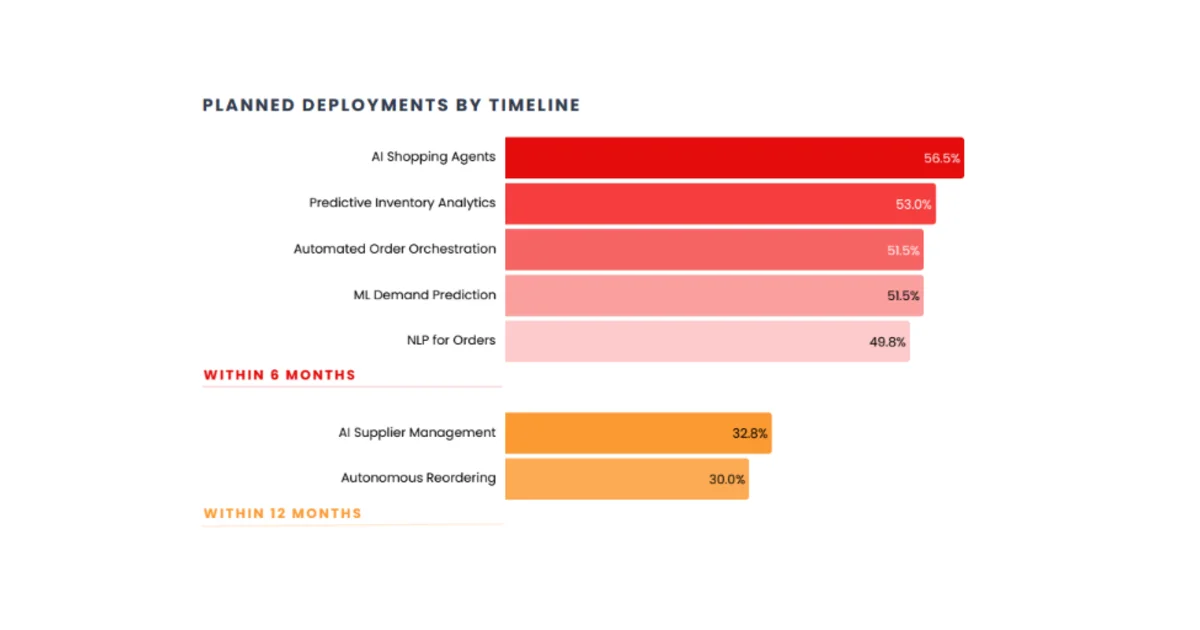
Source: www.businesswire.com
Key Takeaways
- Logicbroker releases "The State of Agentic Commerce Adoption" report surveying 600+ enterprise e-commerce leaders
- One-third of leaders predict AI agents will drive 50%+ of e-commerce transactions by 2027, with 95% already deploying AI
- Integration complexity is the biggest barrier to scale, making multi-platform strategy and data quality improvements urgent priorities
Logicbroker Publishes Agentic Commerce Adoption Survey
Logicbroker Data: AI Set to Drive Over Half of eCommerce Transactions by 2027, Say 1 in 3 eCommerce Leaders
Logicbroker, the Agentic Commerce Orchestration Engine for enterprise retailers and brands that transforms LLM searches into storefronts, today released its State of Agentic Commerce Adoption report.
On March 12, 2026, Logicbroker, an agentic commerce orchestration platform, released "The State of Agentic Commerce Adoption" report. Surveying over 600 enterprise e-commerce leaders, this is the industry's first large-scale report quantitatively demonstrating the extent to which AI agents will transform e-commerce transactions.
Background and Industry Context
Agentic commerce is a new form of e-commerce where AI agents autonomously discover, compare, and purchase products on behalf of consumers. Logicbroker's explainer defines it as "transactions intended by humans, purchased by agents."
Interest in this space has been growing rapidly since late 2025. McKinsey's report suggests AI agents could orchestrate $900 billion to $1 trillion in transactions in the US B2C market alone. Standard protocols connecting AI agents to e-commerce infrastructure are also advancing, including Google's "Universal Commerce Protocol (UCP)" and Anthropic's Model Context Protocol (MCP).
Within this broader industry movement, Logicbroker's survey stands out as the first systematic compilation of how frontline e-commerce leaders actually view these developments.
Five Key Data Points from the Survey
Here are the major findings from Logicbroker's report.
Regarding AI agent impact predictions, over 90% of leaders responded that "AI agents will influence at least 20% of online orders by 2027." More than one-third predict "AI will drive over 50% of all transactions."
Investment scale is rapidly expanding. 95% of companies have already deployed at least one AI-powered commerce capability. 47% plan to invest over $1 million in the next 12 months, with 21% of those expecting to spend over $5 million.
ROI expectations are high, with three-quarters of companies expecting to recoup their investment within 24 months. Nearly half expect returns within one year.
Deployment speed is accelerating, with more than half of organizations planning to deploy AI shopping agents within 6 months.
Regarding market structure, notably, hybrid companies operating both B2B and B2C account for 45% of the market — nearly double that of pure retail companies (22%). Agentic commerce is not just a consumer-facing phenomenon but is also accelerating in complex B2B transaction environments.
"The Biggest Barrier Isn't Convincing the C-Suite"
Logicbroker CEO Omar Qari noted in the press release that AI commerce discussions have historically focused on the "discovery" phase (chatbots, search assistants, recommendations). "But what the data is showing is that AI is starting to move deeply into transactions themselves. When software agents begin deciding what to buy and where to source it, the structure of digital commerce itself changes."
Interestingly, executive buy-in is not a barrier. Only 12% cited leadership alignment as an obstacle. Qari emphasized: "The challenge is not convincing the C-suite; it's connecting systems, improving data quality, and solving the integration complexity needed to scale agentic commerce."
Indeed, 40% of respondents said "better integration tools would accelerate AI adoption." Meanwhile, fewer than 15% of organizations are building proprietary LLMs, with the majority adopting multi-model strategies using multiple commercial AI platforms simultaneously.
Impact and Practical Implications for E-Commerce Businesses
The survey results offer three practical insights for e-commerce businesses.
First, building "AI agent-ready" infrastructure is the top priority. Businesses need to restructure product catalogs into structured, machine-readable formats and establish systems for real-time inventory and fulfillment data delivery via APIs. Ed Bradley, Chief Growth Officer at Logicbroker subsidiary Virtualstock, warns that "legacy retail organizations that aren't AI-ready will be the first to feel the disruption."
Second, dependence on a single platform is a risk. As Qari states, "betting on a single provider in a multi-model market is a risk." Infrastructure capable of supporting multiple AI platforms — ChatGPT, Gemini, Perplexity, and others — is needed. commercetools' 2026 AI trend analysis also highlights multi-agent readiness as a key theme.
Third, traditional SEO and paid advertising channels need reassessment. Bradley points out that "as AI agents autonomously discover, compare, and purchase products, traditional SEO and paid acquisition channels face structural pressure." The quality and structure of data that agents reference becomes the new key to "discoverability."
Summary
Logicbroker's survey demonstrates that agentic commerce is no longer in the conceptual stage but has entered an execution phase with concrete investments and ROI plans. The numbers — 95% of companies already deploying AI capabilities, and over half planning to launch AI agents within six months — speak to the speed of this transformation.
The next point to watch is what results these investments produce in six months. The finding that hybrid B2B/B2C companies dominate the market suggests that agentic commerce's impact extends well beyond consumer-facing e-commerce. Companies that overcome the "real barrier" of integration complexity will become the next leaders in the e-commerce market.
Related Articles

What is Agentic Commerce? Explaining the New Era of AI-Powered Purchasing
Explore the full scope of Agentic Commerce. AI agents autonomously execute everything from product selection to payment on behalf of users. Discover shocking data including 4,700% increase in AI-driven traffic and 20% of Walmart's traffic from ChatGPT, along with three essential preparation steps companies should start immediately.

McKinsey's Automation Curve: A 6-Level Framework for the Future of AI Shopping
McKinsey introduces a 6-level automation curve (Level 0–5) for agentic commerce, predicting AI agents will mediate $3–5 trillion in global consumer commerce by 2030. The competitive axis shifts from eye-catching UI to data quality that AI agents can accurately understand.
75% of Retailers Unprepared for Agentic Shopping - Patchworks Survey Reveals Technology Stack Challenges
Only 27% of UK retailers have technology infrastructure capable of supporting agentic shopping. 60% experience annual revenue losses due to poor system integration, with 10% losing over £1 million annually.
Tags
Share this article