
Why AI Shopping Is Still Just a Smarter Search Bar — The Current State of Agentic Commerce

Akihiro Suzuki
Source: www.pymnts.com
Key Takeaways
- PYMNTS CEO Karen Webster analyzes that AI shopping remains nothing more than a sophisticated search bar
- While 41% of consumers now start product discovery with AI, the infrastructure for completing purchases is missing
- E-commerce businesses must urgently optimize for AI discovery layers and strengthen their own payment and fulfillment foundations
AI Excels at "Researching" but Still Can't "Buy"

Why AI Shopping Is Still Just a Smarter Search Bar | PYMNTS.com
More than a year ago, I asked AI to help me buy a toaster. Not to browse. I knew exactly what I wanted, down to the brand, and I gave the LLM every
On March 18, 2026, Karen Webster, CEO of U.S. payments and commerce media PYMNTS.com, published an analysis declaring the current state of AI shopping "nothing more than a smarter search bar." Webster has been repeating her "toaster test" — asking LLMs to purchase a toaster — for over a year, noting that while AI's research capabilities have improved dramatically, the "transaction loop" of price verification, inventory checks, and payment completion still doesn't work.
Industry Trends
The consumer shift toward AI-powered product discovery is no longer theoretical. According to PYMNTS Intelligence's January 2026 survey, 41% of consumers already use AI platforms for product discovery, with one-third reporting they have "completely replaced" traditional search methods. U.S. adult AI usage reached 54% in January 2026, rising 10 points in just one month.
Among millennials, two out of three use conversational AI assistants for product research. Among AI power users, the share using AI as their primary shopping discovery tool surged from 22% in November 2025 to 34% in December. Consumers are getting ready.
However, a massive gap lies between "discovery" and "purchase." Webster characterizes this as "not a technology failure but a marketplace failure."
Major Players' Struggles and Strategic Pivots
Google's Structural Challenge
Google recorded a 17% increase in search revenue in Q4 2025, and Gemini boasts 750 million monthly active users. Yet since Froogle in 2002, Google Shopping has consistently remained nothing more than a listing service — displaying products and sending consumers to other sites, with transactions, customer relationships, and post-purchase experiences all completed in other ecosystems.
Google's answer is the "Universal Commerce Protocol (UCP)." Announced in January 2026, this open standard was co-developed with over 20 partners including Walmart, Shopify, and Target, aiming to enable AI agents to complete purchases within Gemini. However, Webster argues this is merely "Google Shopping via agents" and evidence that Google itself lacks the ability to build a commerce network.
Shopify's Double Bind
Twelve months ago, Shopify was the standard-bearer of the open web against Amazon. Its partnership with OpenAI to enable ChatGPT in-app checkout drew industry attention. But in March 2026, OpenAI withdrew Instant Checkout. Only about 30 Shopify merchants went live, and the state sales tax collection system remained unbuilt.
Furthermore, Amazon's Shop Direct has emerged as a threat. Handling over 100 million products from 400,000+ merchants, it offers a "Buy for Me" feature enabling Prime users to purchase directly from brand sites using saved credentials. Shopify lacks a fulfillment network, large-scale consumer credentials, or a compelling AI agent.
Amazon as the "Moving Target"
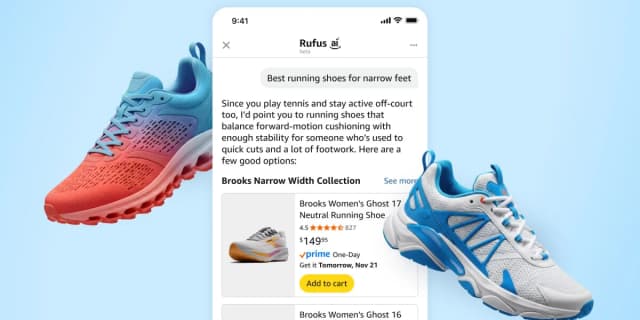
Amazon currently holds the most advantageous position. AI shopping assistant "Rufus" was used by 250 million shoppers in 2025, with monthly active users growing 140% year-over-year. Rufus users show 60% higher purchase completion rates compared to non-users, contributing an estimated additional $10 billion in GMV through the AI assistant.
The decisive difference is that transactions complete the moment the conversation ends. Because the marketplace already exists behind the scenes, there's no gap between "discovery" and "purchase." The strategy of extending this ecosystem externally through Shop Direct — processing all transactions on Amazon's infrastructure — strengthens Amazon's advantage the longer the industry lags.
Walmart's Two-Pronged Approach
Walmart has connected its proprietary AI assistant Sparky to Google's Gemini, deploying Walmart-branded purchase experiences within external AI platforms. Webster characterizes this as "the chatbot version of search ads" while recognizing significant potential in Sparky's domestic strategy of converting 100 million weekly in-store visitors to digital commerce.
Impact on E-Commerce Businesses and How to Leverage
Webster's analysis reveals three priorities e-commerce businesses should address immediately.
Optimizing for the AI discovery layer is urgent. Consumer product discovery channels are shifting from Google Search to ChatGPT, Claude, Perplexity, and others. Businesses should publish product catalogs in formats readable by AI agents and consider supporting protocols like Google UCP and A2P.
Establishing mechanisms for "purchase completion," not just "discovery," is essential. Whether you can provide APIs enabling AI agents to automatically execute inventory checks, price queries, and payment processing will determine future competitiveness. Real-time inventory integration and payment infrastructure preparation are indispensable.
Participation in Amazon Shop Direct should be seriously considered. Especially for DTC (Direct-to-Consumer) brands, acquiring new customers through Prime's payment and logistics infrastructure is a compelling option. Feed integration has been simplified through Feedonomics, Salsify, and CedCommerce.
Summary
What Webster's recurring "toaster test" reveals is not AI's inadequacy but commerce infrastructure's immaturity. While over 70% of consumers want AI agents to shop for them, building the "invisible infrastructure" of inventory integration, payment rails, tax processing, and return policies cannot be completed in a single product cycle.
However, Webster notes the pace is incomparably faster than past commerce infrastructure buildouts. Protocols are being drafted, coalitions are forming, and lessons from early experiments are accumulating. Key developments to watch include UCP's adoption in real transactions, Amazon's Shop Direct expansion pace, and how OpenAI will reconstruct its commerce strategy through a new partnership with Amazon. The tipping point when the "smarter search bar" becomes a "real shopping agent" is drawing ever closer.
Related Articles

The Paradox of Agentic Commerce: AI Wins the 'Search War' but Loses the 'Checkout Battle'
58% of consumers use AI tools for product research, yet only 17% feel comfortable completing purchases through AI. Zero-click searches now account for approximately 60% of all searches, reducing retail site traffic by 15-25%. Eliminating the 'Verification Tax' is the key to mainstream AI commerce adoption.
Amazon Rufus: The Full Picture of the AI Shopping Assistant Used by 250 Million People
Amazon Rufus reaches 250 million users and drives $10 billion in additional sales. Deep dive into its technology, features, and implications for e-commerce.

McKinsey's Automation Curve: A 6-Level Framework for the Future of AI Shopping
McKinsey introduces a 6-level automation curve (Level 0–5) for agentic commerce, predicting AI agents will mediate $3–5 trillion in global consumer commerce by 2030. The competitive axis shifts from eye-catching UI to data quality that AI agents can accurately understand.
Tags
Share this article