
Walmart Drops OpenAI Checkout, Integrates Its Own AI 'Sparky' Directly into ChatGPT

Akihiro Suzuki
Source: www.techbuzz.ai
Key Takeaways
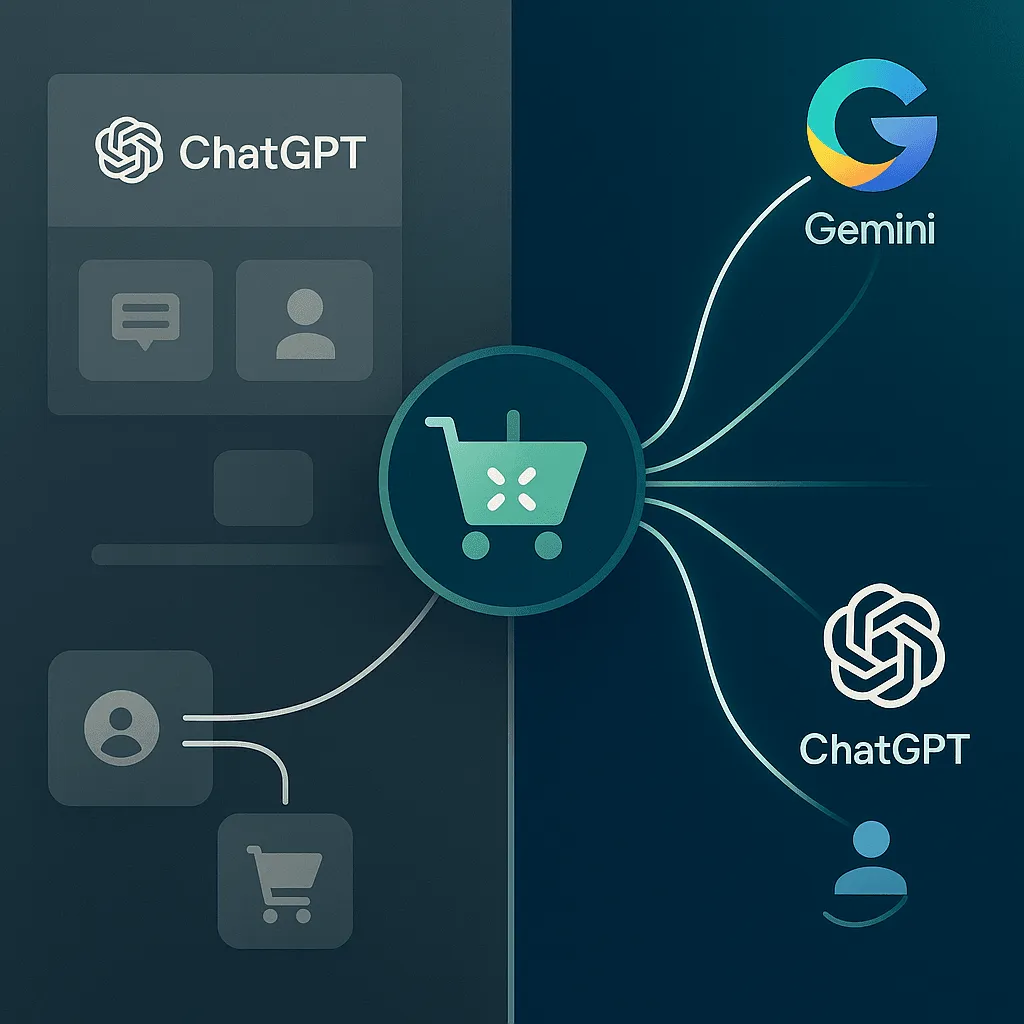
- Walmart discontinues OpenAI's Instant Checkout and integrates its own AI assistant Sparky into ChatGPT and Gemini
- Accuracy issues and declining conversion rates drove the shift, establishing retailer-controlled AI experiences as the new trend
- E-commerce businesses should prioritize building their own brand agents over relying on AI platform checkout features
Walmart Makes Strategic U-Turn, Ends OpenAI's Instant Checkout
Walmart Dumps OpenAI Checkout, Plugs Sparky Into ChatGPT
Walmart replaces OpenAI-powered checkout with its own AI assistant Sparky
On March 18, 2026, Walmart announced the discontinuation of OpenAI's Instant Checkout feature, replacing it with a direct plugin integration of its proprietary AI assistant "Sparky" into ChatGPT and Google Gemini. This strategic pivot comes just five months after the high-profile partnership with OpenAI announced in October 2025.
Walmart commented that "customers expect a consistent experience across every touchpoint," indicating that OpenAI's checkout experience failed to meet quality standards. The rollout for ChatGPT Plus and Gemini Advanced users begins the week of March 18, 2026, with free-tier expansion planned for spring 2026.
Industry Trends
In the latter half of 2025, OpenAI launched "Instant Checkout" on ChatGPT with great fanfare — enabling product search through payment completion. Major players including Walmart, Shopify, and Etsy signed on, and it was heralded as the dawn of agentic commerce.
However, serious problems emerged. OpenAI announced a major scaling back of Instant Checkout in March 2026, driven by multiple structural challenges. Beyond declining conversion rates, only about a dozen of Shopify's millions of merchants actually went live with ChatGPT checkout. Furthermore, as of February 2026, the system for collecting and remitting state sales taxes across U.S. states was reportedly incomplete.
In this context, Walmart's departure from Instant Checkout symbolizes the feature's effective failure. Target had previously declined a similar OpenAI partnership, and Amazon avoided third-party AI integration with Alexa — major retailers are keenly aware of the risks of "entrusting the purchase experience to AI platforms."
Sparky's Capabilities and Walmart's New Strategy
Sparky was announced by Walmart in June 2025 as a proprietary generative AI assistant. Operating on the Walmart app and website, it features product search, review summarization, recommendation suggestions, and alternative product proposals for out-of-stock items. Built by combining proprietary retail data with external large language models, it also plans to support multimodal inputs including text, images, voice, and video.
The key strategic shift is the model inversion from "using OpenAI's checkout" to "deploying Sparky as a plugin into external AI." According to Walmart's pilot program data, purchase completion rates for users accessing Sparky through ChatGPT reached approximately 70% of direct Walmart.com users — significantly outperforming Instant Checkout's conversion rate.
The success factor is that users can make purchase decisions while recognizing the Walmart brand. Customer data, transaction information, and post-purchase relationship building are all managed by Walmart, while reaching the combined 300+ million user base of ChatGPT and Gemini — a "proprietary experience x third-party distribution" hybrid model.
Also noteworthy is the pricing model. Walmart pays a flat API usage fee rather than a revenue share on transactions, suggesting that the retail side holds negotiating leverage. Walmart is also reportedly exploring integration with Anthropic's Claude.
Impact on E-Commerce Businesses and How to Leverage
Walmart's decision contains important implications for e-commerce businesses.
"Building your own AI agent" is no longer an option reserved for large enterprises. Depending on AI platform checkout features risks customer data loss, diluted brand experience, and declining conversion rates. As Walmart demonstrated, the model of deploying your own branded AI assistant to external platforms delivers superior results.
As a concrete action, the first step is to API-ify your product recommendation logic and cart-building mechanisms. It's important to modularize your purchase experience in anticipation of connecting to ChatGPT Plugins, Google Gemini Extensions, and other AI platforms.
Additionally, Walmart has set up sponsored advertising slots within Sparky, enabling brands to secure visibility within the AI assistant through search advertising. Brands advertising through Walmart Connect (retail media) should urgently consider adapting to this new touchpoint.
Summary
The failure of OpenAI's Instant Checkout and Walmart's Sparky integration strategy reveal a new equation for agentic commerce. The era of "entrusting checkout to AI platforms" is giving way to "retailers distributing their own AI to external platforms."
Going forward, key developments to watch include Sparky's free-tier rollout (spring 2026), the trajectory of Anthropic Claude integration, and whether Amazon and Target adopt similar "proprietary AI plugin strategies." The battle for control of AI commerce is shifting from platforms to retailers.
Related Articles

Walmart Distinguishes Agentic Commerce from Robotic Commerce, Details Growth Strategy at Morgan Stanley Conference
Walmart's AI leader explains agentic commerce as a market-expanding growth strategy at Morgan Stanley conference. Presents comprehensive vision for Sparky's evolution across ChatGPT and Gemini platforms and advertising strategy redesign.
OpenAI Effectively Withdraws Instant Checkout, Exposing the 'Horizontal vs Vertical' Divide in Agentic Commerce
OpenAI pivots from ChatGPT's Instant Checkout after just 5 months. The retreat reflects resource reallocation amid intensifying competition, not a failure of agentic commerce itself.

The Agentic Commerce Wars — What the 'Race for the Glass' Means for Interface Supremacy
Forbes columnist analyzes the battle over where AI shopping agents will live. The interface war across OS, browser, protocol, and retail layers will determine who controls customer relationships.
Tags
Share this article