
Walmart Integrates Sparky AI Assistant into ChatGPT as OpenAI Pivots from Instant Checkout to Product Discovery

Akihiro Suzuki

Source: www.retaildive.com
Key Takeaways
- Walmart builds a Sparky-powered app experience within ChatGPT, enabling its own payment and loyalty integration
- OpenAI effectively retreats from Instant Checkout, pivoting to a "product discovery" focus
- E-commerce businesses must prioritize building "discoverability" on AI platforms over in-platform checkout
Walmart Launches Sparky Experience Inside ChatGPT

Walmart brings Sparky to ChatGPT as OpenAI rethinks Instant Checkout
OpenAI is pivoting away from handling purchases after its initial efforts failed to provide enough flexibility.
On March 25, 2026, OpenAI announced on its official blog a major overhaul of ChatGPT's shopping experience. The centerpiece is a new app experience integrating Walmart's proprietary AI commerce agent "Sparky" within ChatGPT.
Walmart's EVP of AI Acceleration, Product and Design, Daniel Danker stated, "Shopping can start from anywhere now. Whether it's on Walmart or a ChatGPT conversation, customers get the same personalized Walmart experience." It is currently available on web browsers, with iOS and Android app support planned in the near future.
The Pivot Away from Instant Checkout's Failure
Behind this move lies the failure of Instant Checkout, which OpenAI launched in September 2025. Instant Checkout was designed as a feature to complete everything from product search to payment within ChatGPT, starting in partnership with Etsy and Shopify. Walmart joined about a month later, listing approximately 200,000 products.
However, the results were disappointing. According to Search Engine Land, the conversion rate for direct purchases within ChatGPT was only "one-third" compared to clicking out to Walmart's own site. Danker himself described the experience as "insufficient."
Forrester principal analyst Emily Pfeiffer told CNBC that "crawling and scraping were insufficient to capture the full picture of product data needed for commerce, including inventory status and shipping costs." Even six months after Instant Checkout's launch, only about 30 merchants were available via Shopify, and product information accuracy remained problematic.
How Sparky Integration Works and What Instant Checkout's Retreat Means
This overhaul involves two major changes.
Migration to Walmart's own app experience. Under the previous Instant Checkout, transactions were processed on OpenAI's payment infrastructure. With the new Sparky integration, a Walmart-managed environment is built within ChatGPT. Users can log into their Walmart account, use loyalty programs, and pay through Walmart's own payment system. Carts sync across the Walmart app, official website, and ChatGPT, delivering a consistent purchasing experience across channels.
OpenAI's strategic pivot to "product discovery." In its official announcement, OpenAI stated, "The initial version of Instant Checkout didn't provide the flexibility we were aiming for. We're enabling merchants to use their own checkout experiences while we focus on product discovery."
Simultaneously, OpenAI revamped its "Agentic Commerce Protocol (ACP)." Merchants can share product feeds and promotional information with OpenAI, enabling more complete catalog display on ChatGPT. Third-party integrations via Salesforce, Stripe, and others are also supported, allowing existing systems to be used as-is. Target, Sephora, Nordstrom, Lowe's, Best Buy, The Home Depot, and Wayfair have already integrated with ACP.
Gartner analyst Bob Hetu analyzed that "OpenAI underestimated how difficult transaction enablement would be."
Impact and Practical Implications for E-Commerce Businesses
This development signals that the "battleground" of AI commerce has shifted from payments to product discovery. Here are the key points e-commerce businesses should address.
Consider ACP integration. OpenAI's Agentic Commerce Protocol is rolling out to all ChatGPT users (Free, Go, Plus, and Pro tiers). It's important to begin preparing to be "discovered" on AI platforms through product feed provision and catalog integration. Shopify merchants in particular can integrate via Shopify Catalog.
Strengthen your own checkout experience. As the destination for users referred from AI platforms, the quality of your site's payment flow becomes more important than ever. As Walmart's case demonstrates, conversions are 3x higher when purchases happen in the merchant's own environment versus generic in-ChatGPT checkout.
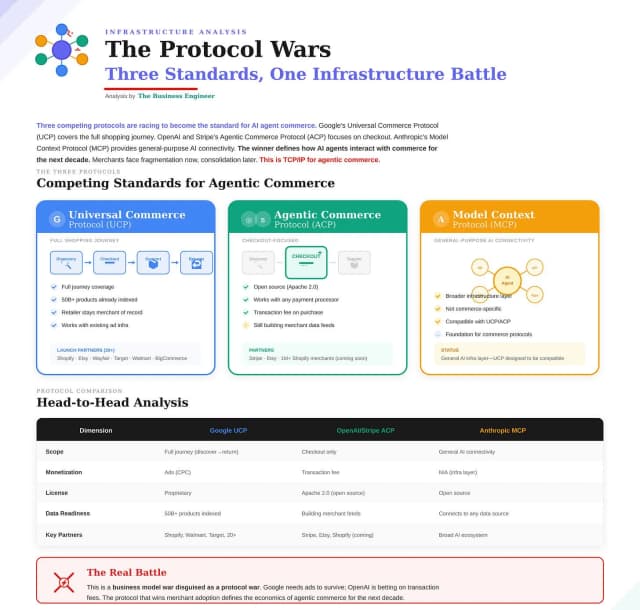
Watch competing platform developments. Google also announced Universal Commerce Protocol (UCP) updates the same week, adding real-time product data loading, multi-product cart additions, and loyalty integration. Walmart's Sparky is planned for Google Gemini integration next month, accelerating multi-platform support.
Summary
OpenAI's retreat from Instant Checkout is not "a failure of AI commerce" but a redefinition of roles. AI platforms specialize in product discovery and recommendations, while retailers handle payments leveraging their own strengths. This division-of-labor model has emerged as the current optimal solution for agentic commerce.
The next action for e-commerce businesses is clear: prepare for conversational AI platforms like ChatGPT and Gemini as "product discovery channels" by organizing product data and establishing feed integration systems. Then, refine your own site experience to reliably convert the users flowing in from these channels. The lessons from Walmart and OpenAI's trial and error should serve as useful guidance for all e-commerce businesses.
Related Articles

Walmart Distinguishes Agentic Commerce from Robotic Commerce, Details Growth Strategy at Morgan Stanley Conference
Walmart's AI leader explains agentic commerce as a market-expanding growth strategy at Morgan Stanley conference. Presents comprehensive vision for Sparky's evolution across ChatGPT and Gemini platforms and advertising strategy redesign.
OpenAI Effectively Withdraws Instant Checkout, Exposing the 'Horizontal vs Vertical' Divide in Agentic Commerce
OpenAI pivots from ChatGPT's Instant Checkout after just 5 months. The retreat reflects resource reallocation amid intensifying competition, not a failure of agentic commerce itself.
Microsoft Copilot Checkout Arrives: AI Commerce Market Now Has Four Major Players
Google, OpenAI, Microsoft, and Perplexity compete for AI commerce dominance with different protocols and revenue models. Here's what e-commerce businesses need to know about each player's strategy.
Tags
Share this article