
Meta AI Tests Shopping Research Feature, Opening New Front Against ChatGPT and Gemini

Akihiro Suzuki
Twitter
Source: www.techi.com
Key Takeaways
- Meta adds a shopping research feature to its Meta AI chatbot, beginning testing with select US users
- Meta's entry with 3.2 billion DAU intensifies competition in the AI commerce market
- E-commerce businesses must urgently optimize product data to prepare for Meta as a new product discovery channel
Meta AI Adds Shopping Features, Now Testing in the US

Meta AI Shopping Tool: New E-Commerce Rival to ChatGPT & Gemini
Meta tests a new AI shopping research tool within its messaging apps to compete with OpenAI and Google.
On March 3, 2026, Bloomberg reported that Meta has added a shopping research feature to its AI chatbot "Meta AI" and begun testing it with select users in the United States.
When accessing Meta AI's web browser version, a "Shopping research" button appears in the query input field. When users submit product-related requests, product images, brand names, prices, and purchase links are displayed in a carousel format, with AI-generated bullet points explaining the recommendation rationale for each product. Business of Fashion confirmed that personalized results are returned based on the user's location and gender inferred from their name.
Currently, no checkout functionality is built in, requiring users to navigate to individual e-commerce sites to complete purchases. Meta has also declined to comment on referral fees or whether ads influence product placement priority.
Background and Industry Trends
AI chatbot-powered shopping assistance has been rapidly expanding since late 2025. OpenAI's ChatGPT led the way with product search and comparison features, and has also enabled in-chat purchase completion through Instant Checkout. Google Gemini has integrated shopping features into its search results as well. According to PYMNTS data, 41% of consumers use AI platforms for product discovery, and 33% have completely replaced traditional search methods.
Against this backdrop, Meta CEO Mark Zuckerberg previewed the launch of "agentic shopping tools" during a January 2026 earnings call. According to TechCrunch, he stated that the tools would "allow people to find just the right set of products from the businesses in our catalog," indicating a strategy to provide "uniquely personal experiences" leveraging users' history, interests, and relationships.
In December 2025, Meta acquired general-purpose AI agent developer "Manus," signaling a commitment to serious investment in agentic commerce. Capital expenditure for 2026 is expected to reach $115 billion to $135 billion, a significant increase from $72 billion the previous year.
Llama-Powered Shopping AI: Architecture and Differentiation
Meta AI's shopping feature is built on the company's proprietary large language model "Llama." The key technical differentiator lies in leveraging data from 3.2 billion daily active users (DAU) across its "family of apps" — Facebook, Instagram, and WhatsApp.
While ChatGPT and Gemini rely on external data, Meta can tap into social graphs, purchase behavior, and content consumption patterns across its platform. This enables personalization that goes beyond simple keyword matching to a deep understanding of user preferences.
Furthermore, Meta is preparing new tools for advertisers. According to Storyboard18, a tool called "Product Set Optimization" is also being tested. This aims to improve campaign performance across multiple SKUs for retail media networks, overcoming the limitations of traditional single-brand advertising algorithms.
Additionally, an AI product codenamed "Avocado" is reportedly under development at Meta Superintelligence Labs, with a launch planned for the first half of 2026. This could further enhance Meta AI's shopping capabilities.
Wall Street has responded favorably. According to TECHi, Wells Fargo analyst Ken Gawrelski raised his price target for Meta stock from $844 to $856, with 37 out of 44 analysts maintaining a Buy rating.
Impact and Action Items for E-Commerce Businesses
The impact of Meta AI's shopping feature on e-commerce businesses spans multiple areas.
Product data optimization becomes the top priority. In a system where Meta AI recommends products, the quality of product titles, descriptions, and images directly affects AI evaluation. Structured product data and SEO-aware metadata management are essential.
Omnichannel strategy redesign is necessary. A joint study by Meta and RAI (Retailers Association of India) found that omnichannel shoppers spend 2.5 times more than single-channel consumers. As Meta AI becomes a starting point for product discovery, a new pathway emerges: social media to AI recommendation to e-commerce site.
WhatsApp Business deserves attention. Meghna Apparao, Meta's Director of E-commerce and Retail, highlighted three priority areas: engagement through Reels and creators, omnichannel performance marketing, and direct commerce via WhatsApp.
There are caveats to keep in mind. Since this is still in the testing phase, availability in other markets remains undetermined. The extent to which advertising spend influences Meta AI's recommendations also remains unclear. For now, the most practical preparation is to register products in Meta's ad catalog and ensure Facebook Shops and Instagram Shopping are properly set up.
Conclusion
Meta's AI shopping research feature enters the AI commerce market with a differentiated approach from ChatGPT and Gemini, armed with a unique combination of 3.2 billion users and social data. Full implementation is expected by mid-2026, with the potential for rapid scaling depending on test results.
What e-commerce businesses should focus on now is ensuring their product data is properly structured for an era where AI "selects" products. A product information strategy that considers optimization across all AI platforms — not just Meta AI, but also ChatGPT and Gemini — will determine competitive advantage going forward.
Related Articles
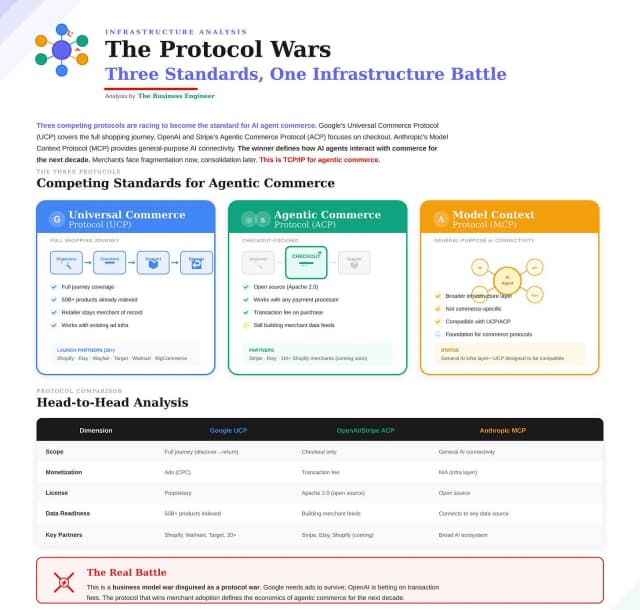
Microsoft Copilot Checkout Arrives: AI Commerce Market Now Has Four Major Players
Google, OpenAI, Microsoft, and Perplexity compete for AI commerce dominance with different protocols and revenue models. Here's what e-commerce businesses need to know about each player's strategy.

Zuckerberg Previews Agentic Commerce: Meta's Q4 Earnings Reveal Full 2026 AI Strategy
Meta's Q4 2025 revenue hits $59.9 billion beating estimates, as Zuckerberg declares 2026 'a big year for delivering personal super intelligence' and previews agentic shopping tools. 3.58 billion users' personal context forms the core of Meta's AI strategy.

As AI Takes Over the Shopping Journey, Stripe and PayPal Race to Become AI Business Infrastructure
Stripe and PayPal race to transform from payment tools to AI business infrastructure, competing to become the default engine for AI-driven transactions.
Tags
Share this article