
Google's Agentic Commerce Goes Live with Etsy and Wayfair — UCP Checkout Moves from Concept to Reality

Akihiro Suzuki
Twitter
Source: www.pymnts.com
Key Takeaways
- Google's Universal Commerce Protocol (UCP) goes live in the US, enabling direct purchases of Etsy and Wayfair products within AI Mode
- UCP reached production just one month after its NRF announcement, with Google Pay integration and Shopify, Target, and Walmart additions on the horizon
- E-commerce businesses must urgently develop a "multi-protocol strategy" covering both UCP and ACP
Google UCP Checkout Goes Live in the US
Google Launches Agentic Commerce With Etsy and Wayfair
Google's standard for connecting businesses and artificial intelligence (AI) agents is beginning to power checkout in the United States.
On February 11, 2026, Google officially launched checkout functionality powered by the Universal Commerce Protocol (UCP) in the United States. The first partners are Etsy, the handmade and vintage marketplace, and Wayfair, the home furnishings e-commerce platform.
US users can now purchase Etsy and Wayfair products directly from Google surfaces while browsing products in Google Search's AI Mode or the Gemini app. Payments leverage Google Pay and shipping information stored in Google Wallet, with PayPal support planned for the future.
Google's VP and GM of Ads & Commerce, Vidhya Srinivasan, stated that "In 2026, agentic commerce is no longer a concept — it's reality," emphasizing that it will "transform the way we shop, from discovery to decision-making."
Background and Industry Context
UCP is an open-source standard announced by Google CEO Sundar Pichai himself at the NRF (National Retail Federation) conference on January 11, 2026. It was co-developed with Shopify, Etsy, Wayfair, Target, and Walmart, with over 20 endorsers including Adyen, American Express, Best Buy, Flipkart, Macy's, Mastercard, Stripe, The Home Depot, Visa, and Zalando.
The speed of reaching production just one month after announcement is remarkable. UCP was designed to solve the "N-to-N integration problem" that plagued traditional commerce infrastructure. According to the Google Developers Blog, UCP applies TCP/IP's layered architecture to commerce, separating responsibilities across three layers: Shopping Service (basic transaction operations), Capabilities (functional units like checkout, orders, and catalogs), and Extensions (domain-specific schema extensions).
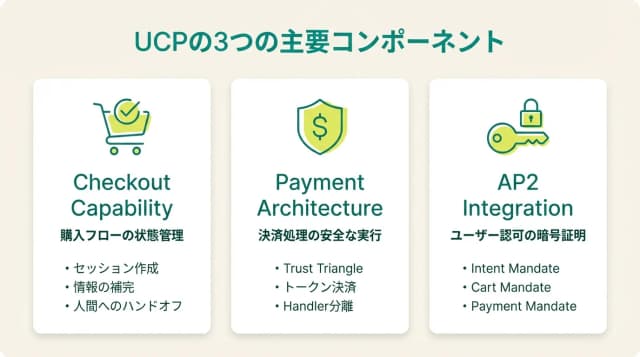
Furthermore, UCP is designed to work in conjunction with the Agent2Agent (A2A) protocol for inter-agent communication, the Agent Payments Protocol (AP2) for agent payments, and Anthropic's Model Context Protocol (MCP). AP2 uses cryptographically signed Mandates to verify user purchase intent, technically preventing erroneous orders caused by AI hallucinations.
Wayfair's Strategic Involvement and Etsy's Position
A particularly noteworthy aspect of this launch is Wayfair's deep involvement as a "co-developer" of UCP. Wayfair CTO Fiona Tan explained that "UCP serves as the common language for this new ecosystem. Agents bridge the gap from discovery to checkout while ensuring that we remain the Merchant of Record."
Wayfair is accelerating investment in AI-powered product discovery, with Tan noting that they are "investing in delivering AI-driven discovery experiences wherever our customers are, whether on our own app or on external AI platforms." Home furnishings is a category where products are high-ticket and comparison shopping tends to be prolonged, making cross-platform AI agent recommendations particularly valuable.
Meanwhile, as a marketplace for handmade and unique products, Etsy has gained a channel for AI agents to recommend "products you can't find anywhere else." Etsy is also an initial partner for OpenAI's Instant Checkout, making it a role model for "multi-protocol" adoption spanning both UCP and ACP.
Intensifying Standardization Competition in Agentic Commerce
Google's UCP checkout launch further accelerates competition over agentic commerce standardization.
OpenAI and Stripe co-developed the Agentic Commerce Protocol (ACP), already implemented as ChatGPT's Instant Checkout feature. Over 1 million Shopify merchants are set to be added, and Stripe's Shared Payment Token (SPT) mechanism enables transactions without exposing payment information to apps. For merchants already using Stripe, integration requires as little as one line of code.
Perplexity has also enabled in-chat purchases through its PayPal partnership, and together with Microsoft's Copilot Checkout, the landscape of AI platform-specific purchase channels is taking shape.
The scale of this market is massive. McKinsey predicts a $3–5 trillion global agentic commerce market by 2030, Morgan Stanley estimates $190–385 billion in the US alone, and Bain & Company estimates that agentic transactions will account for 15–25% of US e-commerce sales. Google's generative AI referral traffic surging 693% during the recent holiday season further supports this trend.
Impact and Action Items for E-Commerce Businesses
Now that Google's UCP checkout is live, e-commerce businesses should consider three key actions.
1. Develop a Multi-Protocol StrategyUCP (Google) and ACP (OpenAI/Stripe) are complementary, not competing. UCP covers the upper funnel (product discovery, comparison, recommendations) while ACP covers the lower funnel (in-chat instant purchases). Following the approach of Walmart and Etsy in supporting both is key to maximizing reach. Major platforms including Shopify are advancing support for both protocols, making this a factor in platform selection decisions.
2. Structure Product Information to Be "Chosen by AI Agents"In agentic commerce, AI compares and recommends products. Registering structured data with Google Merchant Center, real-time updating of inventory, pricing, and shipping information, and clear product descriptions are essential. UCP also provides functionality for merchants to present exclusive discounts directly within AI Mode results, making promotional strategy design important as well.
3. Maintain Merchant of Record Status and Customer RelationshipsUCP's design allows businesses to maintain Merchant of Record status and retain ownership of customer data and post-purchase experiences. However, as Digiday points out, there is a risk that transactions completing within Google's ecosystem could make it harder to control brand experiences and acquire first-party data. Redesigning CRM strategies to rebuild direct relationships with customers acquired through agents is essential.
Summary
Google's UCP checkout going live with Etsy and Wayfair signifies that agentic commerce has transitioned from the "protocol announcement" phase to the "real purchasing experience for consumers" phase. Additional integrations with Shopify, Target, and Walmart are forthcoming, and international expansion to India, Indonesia, and Latin America is planned for the second half of 2026.
Combined with OpenAI's Instant Checkout, Perplexity's PayPal partnership, and Microsoft's Copilot Checkout, an era where multiple AI platforms function as purchase channels has arrived. For e-commerce businesses, adapting to these "new customer touchpoints called AI agents" is beginning to carry importance equal to or greater than traditional SEO and social media marketing. "A product that can't be found by AI doesn't exist" — we are standing at the entrance to that era.
Related Articles
Google Announces Universal Commerce Protocol (UCP), Forms Major Coalition for Agentic Commerce Standardization
Google unveiled UCP at NRF 2026, an open standard co-developed with Shopify, Walmart, and 20+ partners to standardize AI agent-powered shopping experiences.
Klarna Joins Google's UCP — Payment Giant's Entry Accelerates the "Common Language" of Agentic Commerce
Klarna announced joining Google's Universal Commerce Protocol (UCP) on February 2. The move connects 114 million users and 3.4 million daily payment transactions to the AI agent era's standard infrastructure.
Understanding UCP Technical Specifications: How AI Agents Purchase Products
A deep dive into the technical architecture of Google's Universal Commerce Protocol (UCP). Learn about checkout state transitions, the Trust Triangle payment model, and AP2 mandates for conditional automatic purchases.
Tags
Share this article