
EC & AI Commerce News Digest (January 11, 2026)

Akihiro Suzuki
Twitter
Source: www.digitalcommerce360.com
Key Takeaways
- Microsoft announces "Copilot Checkout" enabling purchases within AI assistant, intensifying AI commerce competition
- 58% of consumers use AI tools for product research, but only 17% trust AI for purchase completion
- IKEA's price-cut strategy increases sales volume by 2.6% but reduces profits by 26%
Today's Top News
Microsoft Announces Copilot Checkout, Enabling Purchase Completion Within AI Assistant
Microsoft introduces agentic AI tool Copilot Checkout
Digital Commerce 360
Microsoft and PayPal announced on January 9 a new feature called "Copilot Checkout" that allows users to complete purchases within the AI assistant "Copilot."
With Copilot Checkout, users can search and compare products through conversations with AI and complete payment without navigating to external sites. The payment infrastructure utilizes PayPal, Stripe, and Shopify, with brands like Urban Outfitters, Anthropologie, and Ashley Furniture participating as initial partners. Products from Etsy sellers are also available for purchase.
Shopify merchants are automatically enrolled in Copilot Checkout (with opt-out option), while non-Shopify merchants can apply through Microsoft's portal. With approximately 100 million monthly active users, Copilot doesn't match ChatGPT's 800 million weekly users but has opened a new front in AI commerce against OpenAI, Amazon, and Google.
58% of Consumers Use AI for Product Research, But Only 17% Trust AI for Purchase Completion
58% of consumers use AI tools to research products
Ecommerce News Europe
According to ChannelEngine's "Marketplace Shopping Behavior Report 2026," 58% of consumers use AI tools for product research.
In a survey of 4,500 people across the US, UK, France, Germany, and the Netherlands, 37% reported starting their buying process through an AI assistant. However, only 17% said they feel "comfortable" completing purchases through AI.
While AI has established itself as a tool for product discovery and comparison, the findings show that human judgment and traditional checkout processes still maintain strong trust for final purchase decisions. The survey also revealed that 53% of consumers compare identical products across multiple marketplaces, viewing an average of 3 platforms before making a purchase.
Agentic Commerce
AI Accelerating Back-Office Automation in Payment Operations, Deloitte Report

AI poised to aid payments operations
Shopper bots grab headlines but autonomous AI is likely to transform many business functions, a Deloitte report suggests.
While consumer-facing agentic AI commerce captures attention, Deloitte Consulting's 2026 trends report points to larger business opportunities in back-office operations.
According to Zachary Aron, Deloitte's global payments leader, "AI agents will be deployed in middle and back-office operations such as reconciliation, invoice matching, and exception handling." For companies that have piloted AI, 2026 is predicted to be the year they scale those investments.
AI adoption in payment operations could improve team productivity by 5-45% through automation of document processing, transaction routing, collections, and reconciliation workflows. According to Capgemini's "World Payments Report 2026," 60% of payment tech companies have already deployed GenAI.
Corporate News & Partnerships
Kroger Sells Vitacost to iHerb, Divests Healthcare E-commerce Business
Kroger Announces the Sale of Vitacost.com, Inc.
The Kroger Co. (NYSE: KR) today announced the sale of its subsidiary, Vitacost.com, Inc., an eCommerce retailer of health and wellness products, to...
US supermarket giant Kroger announced on January 9 the sale of its health and wellness e-commerce site "Vitacost.com" to iHerb. The transaction was completed on January 8.
Kroger acquired Vitacost for approximately $280 million in 2014, but this sale was executed as part of a "non-core asset review." The company announced plans to close 60 stores nationwide last year and has reduced its partnership with automated warehouse operator Ocado, focusing on core business operations.
For iHerb, this represents an opportunity to acquire Vitacost's catalog of over 40,000 products and existing customer base, strengthening its US domestic business. iHerb is a global health and wellness e-commerce platform serving 14 million active customers across 180 countries.
IKEA Price-Cut Strategy Increases Sales Volume But Reduces Profit by 26%

IKEA Profits Level Off as Price Cuts Drive 2.6% Volume Growth
IKEA Group reports €1.5 billion profit in FY25, trading margins for volume growth through price cuts after global market fluctuations.
Inter IKEA Group announced in its FY2025 results that net profit fell to 1.5 billion euros (down 26% from 2.2 billion euros the previous year).
The primary cause of profit decline was the implementation of a record-breaking price reduction program. To support consumer purchasing power, IKEA lowered wholesale prices to franchisees, reducing gross margin from 16.0% to 14.2%. However, this strategy increased sales volume by 2.6%, with store visits reaching 915 million, up 2%.
Tariffs and raw material price fluctuations, particularly uncertainty around US trade tariff announcements, pressured earnings. IKEA plans to maintain current price levels in FY2026, expecting "modest growth."
Consumer Trends
Shopify Releases 2025 Holiday Season Gift Trends: DIY Kits and Nostalgic Toys Popular

DIY kits, yo-yos, and glow-ups ruled holiday gifting on Shopify
Retail Brew
According to Shopify's 2025 holiday season data, DIY kits and classic toys recorded significant sales.
In self-care categories, orders for lighted vanity mirrors increased 157%. Bath sponges (46% increase), eye masks (35% increase), and manicure tool sets (34% increase) showed strong "glow-up" gift performance.
In the nostalgic toys category, yo-yos increased 76%, kaleidoscopes 64%, and footbags (hacky sacks) 61%, showing a return to classic playthings. Hula hoops (33% increase) and toy trains (29% increase) also performed steadily.
Party supplies surged heading into the new year, with noise makers (95% increase), party hats (85% increase), cocktail glasses (48% increase), and champagne flutes (40% increase) driving sales.
Global E-commerce Trends
Vietnam E-commerce Market: Logistics Infrastructure Becomes Growth Bottleneck
Vietnam E-Commerce Sector Outlook: Key Growth Trends
Riding the strong momentum of 2024, Vietnam's e-commerce sector is on track to hit US$26–28 billion in 2025.
Vietnam's e-commerce market is expected to reach $26-28 billion in 2025, but lagging logistics infrastructure is becoming a barrier to sustained growth.
Development of warehousing, last-mile delivery, rural coverage, and cold chain lags behind mature markets. New road safety regulations introduced in 2025 have reportedly increased logistics costs for long-distance and heavy cargo by up to 20%.
The "cash burn war" from intensifying platform competition is also a challenge. Heavy investments in discounts, free shipping, influencer marketing, and logistics expansion are squeezing margins. Shortage of specialized talent in data analytics, omnichannel, and AI applications is also constraining growth.
The government approved the "National Strategy for Logistics Services Development 2025-2035" in October 2025. From Phase 4 starting in 2026, the policy aims for more sustainable and regulated growth.
Payments & Fintech
Subscription Commerce Platform Market to Reach $40.2 Billion by 2031

Subscription Commerce Platform Market Positive Indicators Reveal Future Growth Potential to USD 40.2 billion
openPR
According to the latest report from Market Research Intellect, the subscription commerce platform market is projected to reach $40.2 billion by 2031.
The 2024 market size is estimated at $15.5 billion, with projected CAGR (compound annual growth rate) of 12.3% from 2025 to 2031. Expanded industry adoption in consumer goods and retail sectors, along with continuous innovation, will drive growth.
The broader subscription e-commerce market is expected to expand from $20.58 billion in 2025 to $46.05 billion in 2034 (CAGR 9.36%), reflecting growing interest in recurring purchase business models.
Summary
The EC and AI commerce industry on January 11, 2026 was defined by the emergence of a new competitive axis: purchase completion within AI assistants, symbolized by Microsoft's Copilot Checkout announcement. Following OpenAI, Amazon, and Google, Microsoft's full-scale entry accelerates the "conversation to conversion" trend.
However, as consumer research shows, while AI is establishing its role as a product discovery and comparison tool, earning trust for final purchase decisions remains a challenge ahead. As the IKEA case demonstrates, balancing pricing strategy and margin management during inflation is a common theme for retail companies.
Going forward, attention turns to company announcements at NRF 2026 (National Retail Federation Conference). Applications of agentic AI in the retail domain are expected to become more concrete.
Related Articles

Microsoft Announces Copilot Checkout at NRF 2026, Enabling In-AI Purchases with Stripe, PayPal, and Shopify
Microsoft announces Copilot Checkout at NRF 2026, enabling purchases within AI conversations. Shopify merchants auto-enrolled. E-commerce businesses need early preparation for this new sales channel.

What is Agentic Commerce? Explaining the New Era of AI-Powered Purchasing
Explore the full scope of Agentic Commerce. AI agents autonomously execute everything from product selection to payment on behalf of users. Discover shocking data including 4,700% increase in AI-driven traffic and 20% of Walmart's traffic from ChatGPT, along with three essential preparation steps companies should start immediately.
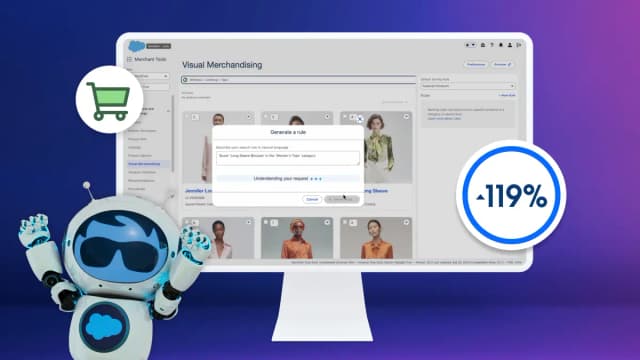
Salesforce Unveils Major Agentforce Commerce Updates with Two-Way AI Communication at NRF 2026
Salesforce announces new Agentforce Commerce features at NRF 2026, enabling two-way AI conversations via SMS, WhatsApp, and email. Companies using AI agents achieved 59% higher growth rates.
Tags
Share this article