
Danish AI Startup Cernel Raises €4 Million Seed Funding to Build Foundational Infrastructure for Agentic Commerce

Akihiro Suzuki
Twitter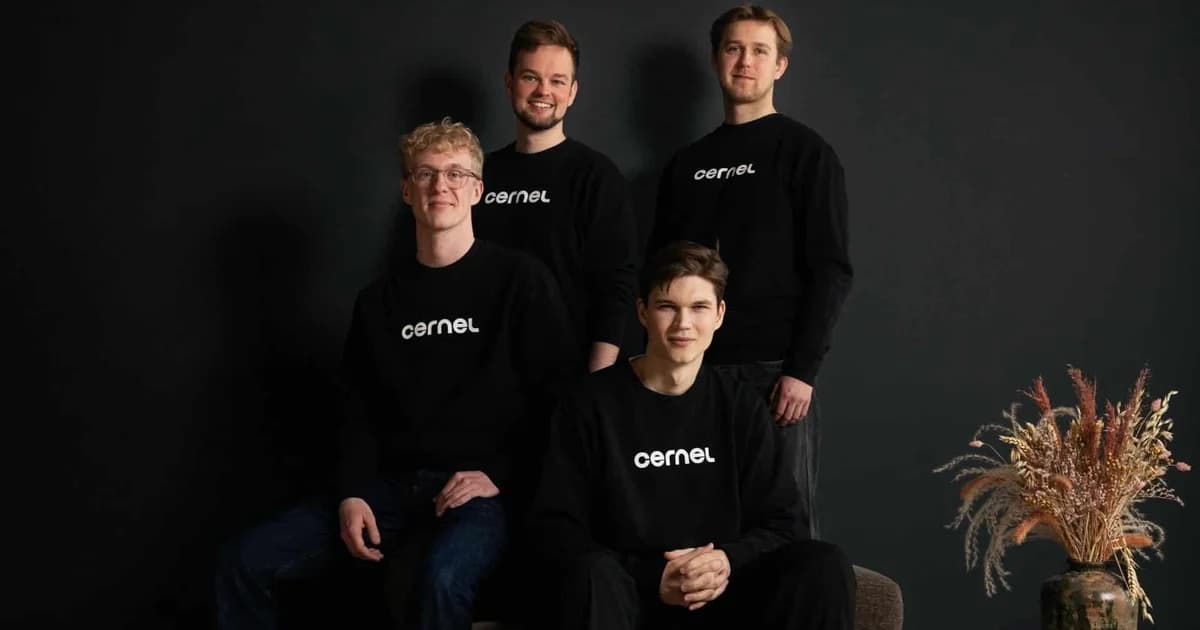
Source: www.eu-startups.com
Key Takeaways
- Denmark-based Cernel closes €4 million seed round led by Seed Capital in just four weeks
- Building a product data foundation for the "agentic commerce" era where AI agents handle purchasing on behalf of consumers
- Structured, machine-readable product data is becoming a prerequisite for search and discovery by AI agents
Cernel Raises €4 Million in Seed Round, Eyes Global Expansion Beyond Nordics

Exclusive: Danish AI startup Cernel raises €4 million in four weeks to 'build foundational infrastructure for agentic commerce'
Cernel, an Aarhus-based startup developing an AI-driven platform for the intelligent management of e-commerce data, today announced a €4 million Seed
On February 23, 2026, EU-Startups reported that Aarhus-based AI startup Cernel has completed a €4 million seed round. The round was led by Seed Capital, one of the Nordics' largest seed funds, with participation from a group of prominent serial entrepreneurs with experience building global-scale businesses. Notably, this round closed in just four weeks.
CEO and co-founder Andreas Busch (age 25) stated: "Demand has far exceeded our expectations. Companies are drowning in product data, and our AI removes the bottlenecks that have been inhibiting growth." The company was founded in 2023 when Busch, Magnus Bruun Rasmussen, Mathias Fenger, and Jacob Lillelund dropped out of Aarhus University.
Industry Trends
Cernel's fundraise is attracting attention because it sits within a massive trend in e-commerce: "agentic commerce." Agentic commerce is a next-generation form of commerce where AI agents autonomously research, compare, negotiate, and purchase products on behalf of consumers and businesses.
McKinsey's October 2025 report predicts that AI agents could mediate $3-5 trillion in consumer commerce globally by 2030. OpenAI announced the "Agentic Commerce Protocol," co-developed with Stripe, building a mechanism for completing purchases within ChatGPT. Major players including Shopify, Amazon, Google, and PayPal have also begun developing agent-enabled shopping infrastructure.
Within this trend, "structured product data" is critically important. McKinsey points out that "if your catalog, policies, and value propositions aren't machine-readable, agents won't be able to find your brand." For e-commerce merchants in the AI agent era, structured product data is a prerequisite for "being discovered." This structural shift is the backdrop for Cernel positioning itself as "foundational infrastructure for agentic commerce."
Cernel's Platform: From Automated Data Structuring to Image Generation
Cernel is building an AI-native platform that automates the entire "product data pipeline" for e-commerce companies. According to the official website, the platform comprises three main functional areas.
Product Data Foundation automatically normalizes disparate data formats from suppliers and maps attributes to target channels. It also includes an "enrichment" capability that appends verified attributes from brand databases and product registries. Cernel's website claims an 85% reduction in manual work and 95% faster time-to-market.
Media Content uses AI to generate model-on shots, environmental shots, seasonal visuals, and UGC-style content from a single white-background product image. Once brand guidelines are set, a consistent visual identity is applied across all products.
Market and Feed Optimization performs automatic formatting to match attribute requirements for each sales channel, including Google Shopping, Amazon, and Shopify. A distinctive feature is that translations are generated as original content in each language from enriched product data, rather than converting from source text.
Cernel integrates these capabilities and positions itself as a "reasoning layer" that transforms fragmented product information into "structured data assets" processable by AI agents. Seed Capital GP Geeta Schmidt commented: "The Cernel team has built a true reasoning layer for commerce. I'm convinced this will become the infrastructure supporting global retail for the next decade."
The company previously raised €765,000 in a pre-seed round in 2024 led by Danish early-stage VC Founderment, with participation from the Danish Export and Investment Fund (EIFO) and angel investors.
Impact and Strategies for E-commerce Merchants
Cernel's momentum sends a clear message to e-commerce merchants.
Structured product data is shifting from "nice to have" to "must have." As Modern Retail reports, 2026 is the year AI shopping agent competition heats up. Unstructured product data becomes "invisible" to AI search and recommendation systems.
There are three specific actions to take. First, audit whether your product data is in a machine-readable state. Second, verify that attribute requirements for each sales channel are being met. Third, evaluate automated multilingual support and visual content generation.
However, there are caveats. Cernel's existing customers are primarily Nordic brands such as Matas, Firtal, Hummel, and Vero Moda. While this funding round targets "global expansion beyond the Nordics," the timeline for expansion to the Japanese market is undetermined. It's important to also evaluate other solutions addressing similar challenges (Akeneo, Salsify, Syndigo, etc.) and select the optimal tool for your e-commerce operations.
Conclusion
Cernel's seed round underscores the growing importance of product data infrastructure in the "agentic commerce" era. In a future where AI agents handle shopping on behalf of consumers, structured and machine-readable product data becomes the lifeline for e-commerce merchants to "be discovered."
Key points to watch are Cernel's speed of expansion beyond the Nordics and how far major platforms like OpenAI, Shopify, and Amazon progress in agent-enabled capabilities. As eCommerce Times notes, 2026 may be "the year unified platforms and agentic AI define e-commerce." For e-commerce merchants, revisiting product data strategy is no longer a "proactive investment" — it is becoming a "survival requirement."
Related Articles

McKinsey's Automation Curve: A 6-Level Framework for the Future of AI Shopping
McKinsey introduces a 6-level automation curve (Level 0–5) for agentic commerce, predicting AI agents will mediate $3–5 trillion in global consumer commerce by 2030. The competitive axis shifts from eye-catching UI to data quality that AI agents can accurately understand.

What is Agentic Commerce? Explaining the New Era of AI-Powered Purchasing
Explore the full scope of Agentic Commerce. AI agents autonomously execute everything from product selection to payment on behalf of users. Discover shocking data including 4,700% increase in AI-driven traffic and 20% of Walmart's traffic from ChatGPT, along with three essential preparation steps companies should start immediately.
75% of Retailers Unprepared for Agentic Shopping - Patchworks Survey Reveals Technology Stack Challenges
Only 27% of UK retailers have technology infrastructure capable of supporting agentic shopping. 60% experience annual revenue losses due to poor system integration, with 10% losing over £1 million annually.
Tags
Share this article