
Amazon Launches AI-Generated 'Canvas' for Sellers — Dashboards Go Conversational

Akihiro Suzuki
Twitter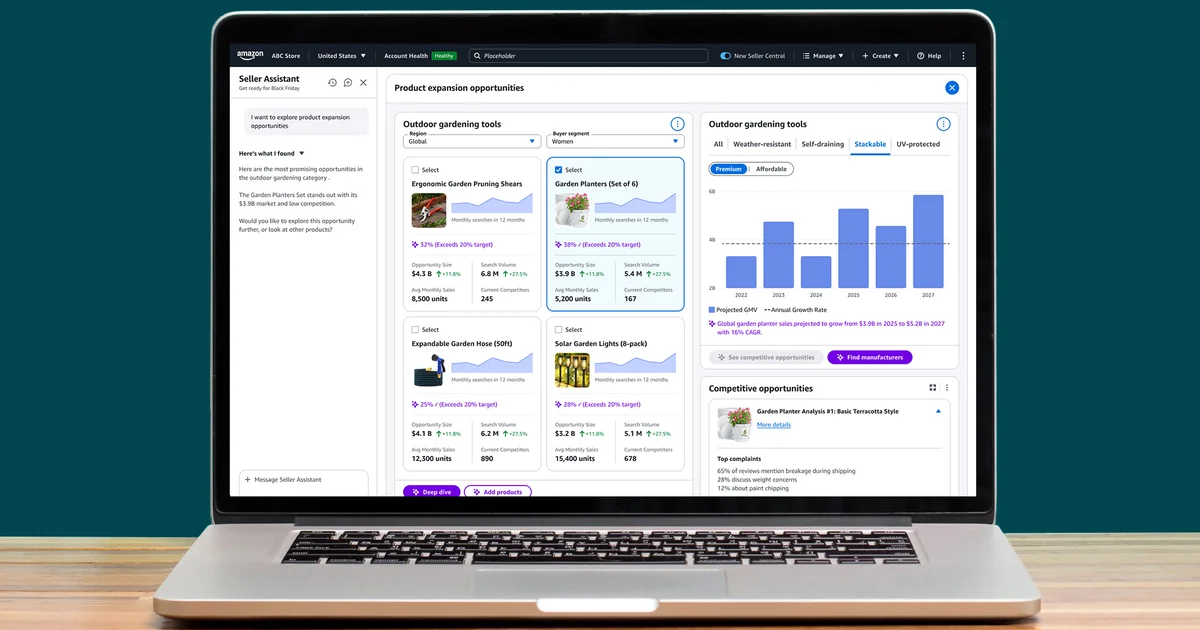
Source: www.geekwire.com
Key Takeaways
- Amazon launches Canvas in Seller Central, generating dashboards from natural language prompts for free
- AI seller tool competition among e-commerce platforms intensifies, with agentic AI becoming standard
- Sellers can break free from static reports and make decisions through real-time data conversations
Amazon Introduces Canvas to Seller Central

Amazon launches AI-generated 'canvas' for sellers as e-commerce platforms race to add AI tools
Amazon is rolling out a 'dynamic canvas' in Seller Central that generates personalized visual dashboards in response to seller prompts, building on its existing AI-powered Seller Assistant.
On March 4, 2026, Amazon launched Canvas, a new feature in Seller Central, available for free to all sellers in the United States and United Kingdom. The launch was reported by GeekWire.
Canvas is a feature where sellers input natural language prompts and AI generates personalized visual dashboards in real time. It integrates sales data, inventory status, customer traffic, and recommended actions into a single view, significantly expanding the capabilities of the existing AI chat assistant, Seller Assistant.
Background and Industry Trends
Behind this release is the intensifying competition among e-commerce platforms for AI seller tools. On Amazon's marketplace, over 60% of sales come from independent third-party sellers. According to PYMNTS, these sellers manage complex operations including inventory management, marketing optimization, and demand forecasting with small teams, and demand for AI tools continues to grow.
Competitors are also making active moves. Shopify significantly upgraded its AI assistant Sidekick in 2025, adding multi-step reasoning and advanced analytics capabilities. In its Winter 2026 RenAIssance Edition, it announced over 150 AI-related product updates. Meanwhile, Walmart showcased AI listing tools and smart assistants at its August 2025 Marketplace Seller Summit, with seller count surpassing 200,000 for the first time.
Against this backdrop, Amazon has evolved the foundation built with Seller Assistant into Canvas, elevating the experience from simple chat responses to a visual workspace.
Four Key Features of Canvas
According to the official Amazon blog, Canvas provides functionality across four areas.
Business Performance Analysis auto-generates dashboards integrating sales data, customer traffic, and trend analysis. Sellers simply enter questions, and AI proactively presents insights such as sales spike detection and inventory increase recommendations.
Marketing Optimization analyzes ad spend, impressions, conversions, and per-product sales lift, proposing multiple future strategies with predicted outcomes. Sellers can adjust parameters through a conversational interface.
Inventory Planning functions as a decision simulator. It forecasts the impact on sales, cash flow, stockout risk, storage fees, and competitive position across multiple options including immediate replenishment, waiting, and overstock markdowns. What-if scenarios such as "what if demand drops 10%" are also executable.
Product Launch Strategy combines historical sales trends, customer insights, category demand signals, and competitive intensity to generate prioritized launch options with clear investment-risk tradeoffs.
On the technical side, Canvas is built on Amazon Bedrock and employs an agentic commerce architecture that leverages Amazon Nova and Anthropic Claude as models. A key differentiator is that Amazon's 25-plus years of seller support expertise is embedded into the system.
Impact and Practical Applications for E-Commerce Businesses
The introduction of Canvas has the potential to fundamentally change how e-commerce businesses utilize data.
Mary Beth Westmoreland, VP of Amazon Worldwide Selling Partner Experience, noted that sellers accept Seller Assistant's recommended actions at a rate of approximately 90%. This high adoption rate indicates that AI suggestion accuracy aligns with sellers' practical needs.
Charlene Anderson, founder of Purveyor of All Things Creative and an actual user, commented that information gathering and analysis that previously took hours now completes in seconds with Canvas, giving her greater confidence in inventory management and product line expansion decisions.
For practical adoption, the key is to start with the currently available performance analysis features to become comfortable with visualizing sales trends and inventory status. Marketing optimization, inventory planning, and product launch features will be added progressively over the coming months, with country and language expansion planned for the second half of 2026.
However, there are caveats. Some seller forums have reported broken links in AI tools and dissatisfaction with generic recommendations. It is important not to take AI suggestions at face value but to evaluate them against your own business context.
Conclusion
Amazon's Canvas launch marks a turning point where AI tools for sellers on e-commerce platforms evolve from chat-based assistants to visual workspaces. Sellers' workflows are beginning to shift from static report review to real-time data conversations.
As Shopify, Walmart, and Amazon compete to enhance their AI seller tools, the key question going forward is how far agentic AI will go in autonomously executing actions. While Canvas currently focuses on analysis and recommendations, there is significant potential for AI to progress to automatically executing inventory orders and ad bidding in the future. It will be important to continue monitoring expansion timelines beyond the US and UK, as well as the rollout schedule for additional features.
Related Articles

Amazon Rufus: The Full Picture of the AI Shopping Assistant Used by 250 Million People
Amazon Rufus reaches 250 million users and drives $10 billion in additional sales. Deep dive into its technology, features, and implications for e-commerce.

Shopify Declares 'AI Agents Will Not Bypass Our Checkout' — Platform Strategy for the Agentic Commerce Era
Shopify affirms that AI agent-driven shopping will still be processed through its own checkout infrastructure. With AI-driven orders surging 15x, the battle for agentic commerce leadership intensifies.

The AI Commerce Three-Way Battle: Google, Amazon, and OpenAI Clash Over the Next-Gen E-Commerce Market
Google, Amazon, and OpenAI are competing with different approaches in the AI commerce market. McKinsey predicts a $3-5 trillion market opportunity by 2030. E-commerce businesses need to prepare for multi-protocol support.
Tags
Share this article