
AI Agents Threaten Amazon and eBay—Giant Marketplaces Forced to Redefine Their Raison d'Être

Akihiro Suzuki
Twitter
Source: www.paymentsdive.com
Key Takeaways
- eBay has updated its terms of service to explicitly ban AI "buy-for-me" agents, while Amazon has sued Perplexity AI
- In a world where AI agents autonomously complete everything from product search to payment, traditional marketplaces risk being reduced to "backend fulfillment providers"
- E-commerce businesses must urgently consider protocol adoption and data structuring to expose their brands and products to agent-driven discovery and purchasing
The "AI Commerce Threat" Confronting Giant Marketplaces
How AI commerce threatens eBay, Amazon
Agentic robots that shop and pay without human involvement could potentially render retail marketplaces obsolete – and big merchants are responding.
On February 4, 2026, Payments Dive reported that autonomous commercial transactions by AI agents (agentic commerce) are fundamentally shaking the raison d'être of giant marketplaces like Amazon and eBay. In a world where AI robots search for products, compare them, and complete payments without human involvement, the marketplace business model built on "access to a massive consumer pool" may no longer hold.
Adam Behrens, CEO of agentic commerce tool developer New Generation and former Stripe executive, points out: "If you look at what ChatGPT and Google are trying to do, the LLM becomes the marketplace itself. Connect supply to the LLM, have consumers interact there, and why would you need to go to Amazon?" Under this model, traditional e-commerce marketplaces become nothing more than "backend fulfillment providers."
Industry Trends
The impact of AI agents on e-commerce is no longer theoretical. AI browser and agent-driven traffic to US online retail sites has surged 4,700% year-over-year. Shopify reports that since January 2025, AI-driven traffic has increased 7x and AI-driven orders 11x. Morgan Stanley projects agentic shopping will reach $190-385 billion in US e-commerce spending by 2030, while McKinsey estimates orchestration revenue from agentic commerce in US B2C retail alone could reach up to $1 trillion by 2030.
The current AI commerce evolution is transitioning from a phase where "AI handles product research while humans complete payment" to "fully autonomous end-to-end transactions from search to payment." According to a related Payments Dive article, a significant gap still exists between "bot shopping" and "autonomous payment," but that gap is closing rapidly.
eBay and Amazon—A Two-Front Strategy of "Exclusion" and "Co-optation"
eBay: Explicitly Banning AI Agents via Terms of Service
eBay's terms of service update effective February 20, 2026 prohibits "buy-for-me agents, LLM-driven bots, or end-to-end flows that attempt to place orders without human review" without eBay's prior authorization. According to EcommerceBytes, eBay also updated its robots.txt file in December 2025, specifically blocking Perplexity, Anthropic, and others (while exceptionally allowing Google's shopping bots).
Meanwhile, eBay is steadily advancing its own AI agent strategy. CEO Jamie Iannone stated in the Q3 2025 earnings call that the company is "piloting its own LLM for commerce" and would "progressively roll out agentic capabilities into eBay's core search experience in the coming quarters." An eBay spokesperson explained they are working with partners including OpenAI to expose inventory to third-party agents that understand eBay's value-added services like managed shipping and money-back guarantees.
In essence, eBay's policy is: "Block unauthorized AI agents, but welcome those that understand eBay's rules and obtain permission." E-Commerce Times characterized this as "passing on agentic shopping for now, while preparing to accept it on their own terms."
Amazon: Legal Action Against Perplexity, Promoting In-House AI
Amazon sued Perplexity AI in San Francisco federal court in November 2025, alleging that Perplexity's agentic shopping tool "Comet" was accessing Amazon's stores and customer data without authorization and seeking an injunction.
Amazon's complaint states: "Like any other trespasser, Perplexity is not permitted to enter property it has been clearly told it may not enter. The fact that Perplexity's trespass is accomplished through code rather than lock-picking tools makes it no less unlawful." Perplexity CEO Aravind Srinivas pushed back, calling it "bullying tactics to suppress competition" and arguing that AI agents should have the same rights as human users.
The core issue identified by Perplexity's legal team is advertising revenue. "AI agents don't have eyes to see the ads Amazon bombards users with"—when Comet completes a purchase on Amazon on behalf of a user, the consumer never actually visits Amazon's site, eliminating opportunities for sponsored product displays, Prime membership recruitment, and commercial data collection.
Interestingly, Amazon itself is testing an AI agent feature called "Buy For Me," which allows AI to purchase products from external brand sites within the Amazon app. Critics point to a double standard: "Amazon allows its own AI agents to purchase on other sites while using lawsuits to block other companies' AI agents from purchasing on theirs."
Payment Networks and Tech Companies Respond
Payment infrastructure companies are also responding to this structural shift. Mastercard announced on January 27, 2026 its agentic AI tool suite "Mastercard Agent Suite," planned for enterprise customer delivery by end of Q2 2026. Through Google's Universal Commerce Protocol and OpenAI's agentic protocol, it enables cross-platform transactions with secure credentials and verifiable agent IDs.
Similarly, Visa is building AI commerce security infrastructure in partnership with OpenAI, IBM, Anthropic, and Microsoft, while Stripe is developing payment protocols for Etsy and Shopify merchants via ChatGPT in collaboration with OpenAI.
However, fraud risk concerns are also escalating. Jeff Otto, CMO of fraud management software provider Riskified, warns of "losing on both fronts—loss of customer relationships and increased fraud risk from essentially outsourcing payment trust decisions to systems outside your control." At Money 20/20 2025, JPMorgan Chase's Mike Lozanoff raised the issue of "AI agents hallucinating and buying products they weren't instructed to purchase."
Impact on E-Commerce Businesses
In the midst of this upheaval, the actions e-commerce businesses should take can be distilled into three priorities.
First, data preparation to be "chosen by agents." AI agents discover and compare products through structured data and APIs. As New Generation's Behrens states, "The paramount question for merchants is how to expose their brand, data, and products to this ecosystem." Businesses need to prepare to publish product catalogs, inventory, pricing, and shipping terms in agent-readable formats.
Second, a diversification strategy away from marketplace dependency. In a world where AI agents bypass marketplaces to access brand sites directly, making your own e-commerce site agent-compatible becomes a new channel to avoid marketplace fees. Businesses should consider adopting MCP (Model Context Protocol) and Google's UCP (Universal Commerce Protocol).
Third, preparing for fraud risks. Agent-driven transactions render the traditional security model based on "humans viewing and operating screens" obsolete. Redesigning agent authentication, transaction monitoring, and chargeback countermeasures is essential. Monitor developments in infrastructure standards like Mastercard's verifiable agent IDs and establish early response capabilities.
Summary
eBay's AI agent ban and Amazon's Perplexity lawsuit are defensive actions to protect their business models, while simultaneously representing two sides of a "exclude while co-opting" strategy. AI agents becoming the new interface for commercial transactions is inevitable—the question is not "when" but "on whose terms." For e-commerce businesses, this transformation represents both a threat and an opportunity to build new customer touchpoints independent of marketplace fees. 2026 will be the year when the rules for this new era take shape.
Related Articles

eBay Completely Bans AI Shopping Bots in Terms of Service, Major EC Platforms Tighten Regulations
eBay updates terms of service to explicitly prohibit 'buy-for-me' AI agents. Regulations on autonomous AI purchasing rapidly expanding among major EC platforms
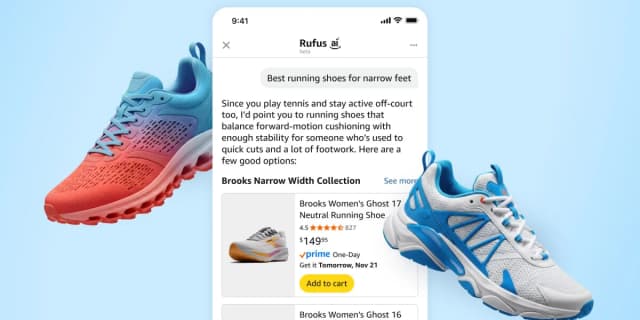
Amazon Rufus: The Full Picture of the AI Shopping Assistant Used by 250 Million People
Amazon Rufus reaches 250 million users and drives $10 billion in additional sales. Deep dive into its technology, features, and implications for e-commerce.

The Wide Gap Between AI Bot 'Shopping' and 'Payments' — Where Agentic Commerce Stands Today
AI bots excel at product search and comparison but a significant gap remains before autonomous payment completion. Visa, Mastercard, and Google compete with proprietary protocols as industry standards proliferate. E-commerce operators should begin evaluating agent support as a new customer channel.
Tags
Share this article