
Technical Guide for EC Merchants to Prepare for Google UCP -- The Era of 'Optimization for Selection' Begins

Akihiro Suzuki
Twitter
Source: www.searchenginejournal.com
Key Takeaways
- Search Engine Journal publishes comprehensive technical guide for Google UCP readiness, proposing new concept "ACO (Agentic Commerce Optimization)"
- UCP covers the entire commerce lifecycle from product discovery to loyalty, not just checkout, fundamentally changing the basis of EC competition
- EC merchants should immediately begin structured data audits, Merchant Center feed optimization, and conversational commerce attribute configuration
SEJ's Technical Guide Outlines the Full Picture of UCP Readiness

Agentic Commerce Optimization: A Technical Guide To Prepare For Google's UCP
UCP expands commerce beyond checkout into discovery, loyalty, and post-purchase support, redefining how brands compete for AI-mediated selection.
On February 23, 2026, Search Engine Journal published a guide for EC merchants on preparing for Google's Universal Commerce Protocol (UCP). The author is Alex Moss, Principal SEO at Yoast. He proposes a new concept called "ACO (Agentic Commerce Optimization)" and argues that the focus of SEO optimization is shifting from "clicks" to "selection by AI agents."
UCP is an open-source protocol announced by Google in January 2026, serving as a common language that seamlessly connects AI agents with EC merchants' systems. On February 11, Google's VP/GM Vidhya Srinivasan already announced that UCP-enabled checkout went live on Wayfair and Etsy. Shopify, Target, and Walmart are expected to follow shortly.
Industry Trends
In traditional EC, consumers have been forced to choose between "buying quickly and risking a mismatch" or "spending time researching to find the right answer." With the emergence of AI agents, this structure is about to fundamentally change.
Google announced AP2 in 2025, and at the January 2026 NRF (National Retail Federation) conference, CEO Sundar Pichai formally announced UCP. According to the Google Developers Blog technical overview, UCP is compatible with AP2 while supporting multiple communication methods including A2A and MCP.
Notably, UCP development is not a Google-only effort. Shopify participates as a co-development partner, and over 20 global partners including Adyen, American Express, Mastercard, Stripe, and Visa have expressed support. According to Search Engine Land, the entire industry views agent-led commerce as "an inevitable trend."
UCP's 6 Core Capabilities and ACO
Alex Moss's guide organizes UCP into six layers.
Product Discovery is the mechanism by which AI agents search and present inventory. Cart Management handles multi-item basket operations and dynamic pricing. Identity Linking connects personalization and loyalty programs via OAuth 2.0. Checkout covers everything from session generation to tax calculation and payment processing. Order Management provides webhook-based lifecycle management. And Vertical Capabilities offer industry-specific feature modules for travel, subscriptions, and more.
Shopify's engineering blog describes this architecture as having "the same design philosophy as TCP/IP's layered structure." Above the core shopping services sit independently versioned "Capabilities," with domain-specific "Extensions" layered on top. Merchants implement only the features they need, and agents negotiate only the capabilities they support, minimizing the burden on both sides.
5 Actions EC Merchants Should Take Now
The specific actions outlined in Moss's guide are clear.
First, conduct a thorough structured data audit. While UCP uses its own JSON schema, schema.org remains important as the foundation for agents to determine "who to transact with." As Pascal Fleury stated at Google Search Central Live, "schema is the glue that ties all ontologies together." Product schema, Offers, shippingDetails, FAQPage, and more must be comprehensively implemented.
Second, optimize Merchant Center feeds. UCP leverages existing Merchant Center feeds as its discovery layer. Complete return policies, adding the native_commerce attribute, and accurate product ID configuration are essential. Google recommends setting these additional data points as supplemental data sources rather than primary feeds.
Third, leverage conversational commerce attributes. VP/GM Srinivasan announced that "dozens of new data attributes will be added to Merchant Center." By configuring not just FAQs but also compatible accessories (upsell opportunities), alternatives (out-of-stock mitigation), and related products (cross-sell opportunities), merchants can gain an advantage in AI agents' selection process.
Fourth, strengthen third-party reviews. Ratings on review platforms like Trustpilot and G2 remain important as third-party sources that LLMs trust. On-site optimization alone is insufficient; accumulating positive brand and product reviews contributes to "consensus" formation.
Fifth, register for the UCP waitlist and understand the technical documentation. Having development teams understand the technical specifications on the official UCP site early prevents falling behind during rollout.
Impact on EC Merchants and How to Leverage
UCP's impact extends beyond retail. The roadmap explicitly mentions expansion to multi-item carts, loyalty integration, post-purchase support, personalization, and travel, services, and digital goods.
For Japanese EC merchants, it's particularly important to note that UCP-enabled checkout is currently only available in the US. However, given that AI Mode is being integrated as the default experience powered by Gemini 3, global expansion is only a matter of time. Structured data optimization and Merchant Center feed refinement enhance SEO effectiveness regardless of UCP readiness, so there's no downside to starting immediately.
Additionally, EC merchants using Shopify are in the best position to benefit from UCP support earliest. As a co-development partner, Shopify states that UCP integration through Checkout Kit can be "achieved with just a few lines of code."
Summary
UCP is not merely a checkout protocol but an open standard covering the entire commerce lifecycle from product discovery to post-purchase support. As the new optimization concept Moss named "ACO" indicates, the competitive axis for EC merchants is definitively shifting from "winning clicks" to "being selected by AI agents."
Google positions this as "the biggest change in the EC industry," warning that companies waiting for full rollout are already falling behind. The four pillars of schema auditing, Merchant Center optimization, conversational attribute configuration, and third-party review strengthening should be prioritized starting today.
Related Articles

Google Announces Universal Commerce Protocol (UCP), Forms Major Coalition for Agentic Commerce Standardization
Google unveiled UCP at NRF 2026, an open standard co-developed with Shopify, Walmart, and 20+ partners to standardize AI agent-powered shopping experiences.
Understanding UCP Technical Specifications: How AI Agents Purchase Products
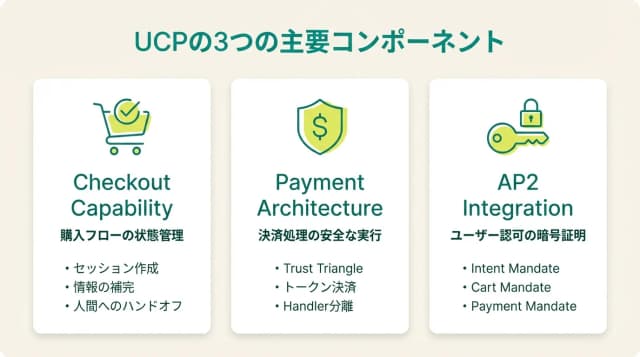
A deep dive into the technical architecture of Google's Universal Commerce Protocol (UCP). Learn about checkout state transitions, the Trust Triangle payment model, and AP2 mandates for conditional automatic purchases.

MCP, A2A, UCP — Making Sense of the Proliferating Agentic AI Protocols
The Register systematically categorizes and explains major agentic AI protocols including MCP, A2A, and UCP. Standardization gains momentum with the Linux Foundation's AAIF establishment
Tags
Share this article