
Adobe Commerce Announces Support for Agentic Commerce Standards 'UCP' and 'ACP' — Redefining the Shopping Experience for the AI Era

Akihiro Suzuki
Twitter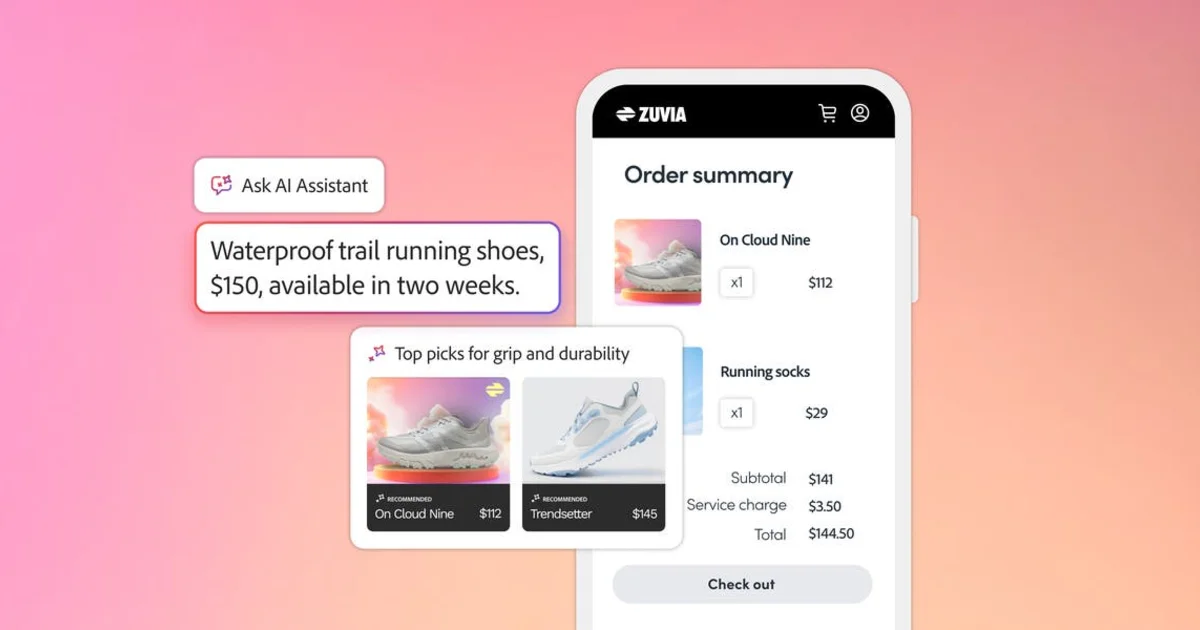
Source: business.adobe.com
Key Takeaways
- Adobe Commerce commits to supporting both Google-led UCP and OpenAI-led ACP
- As AI-driven shopping traffic surges, multi-protocol support becomes a competitive imperative
- E-commerce businesses should begin optimizing product data for AI and preparing for multiple protocols now
Adobe Commerce Commits to Major Agentic Commerce Standards

Adobe Commerce expands support for agentic commerce standards
Adobe Commerce now supports UCP and ACP to help brands boost discovery across AI-powered shopping and deliver secure, seamless agentic buying experiences.
On February 18, 2026, Adobe announced via its official blog that Adobe Commerce will support both Google's "Universal Commerce Protocol (UCP)" and OpenAI's "Agentic Commerce Protocol (ACP)." This follows the company's earlier commitment to Google's "Agent Payments Protocol (AP2)."
With this support, brands using Adobe Commerce will be able to make their products discoverable and purchasable through AI interfaces such as ChatGPT and Gemini, while maintaining control over customer relationships, branding, and commerce data.
Background and Industry Trends
AI agents are fundamentally transforming purchasing behavior. According to an Adobe Digital Insights report, AI-driven traffic to retail sites during the 2025 holiday season surged 693% year-over-year. Furthermore, as of January 2026, AI-referred visitors show a 31% higher conversion rate, 254% greater revenue per visit, and 45% longer site dwell time.
Against this backdrop, Google announced UCP on January 11, 2026. More than 20 global partners including Shopify, Etsy, Wayfair, Target, and Walmart have endorsed the standard. Meanwhile, ACP, led by OpenAI and Stripe, emerged in the second half of 2025, and purchasing products from Etsy and Shopify on ChatGPT is already a reality.
The coexistence of these two protocols mirrors the historical coexistence of Apple Pay, Google Pay, and PayPal. As Checkout.com's analysis notes, e-commerce businesses are entering an era where "multi-protocol support" is required.
UCP vs. ACP, and Adobe Commerce's Strategy
UCP and ACP both aim for "seamless purchasing experiences through AI agents" but take different approaches.
UCP (Universal Commerce Protocol) is an open standard led by Google. It covers the entire shopping journey from product discovery to checkout and post-purchase support. Currently, it is deployed on Google services including Google Search AI mode and the Gemini app, and supports payment authentication via AP2. It is designed to enable retailers to transact with AI agents while maintaining their position as "sellers."
ACP (Agentic Commerce Protocol) is a cross-platform open standard co-developed by OpenAI and Stripe. Its distinguishing feature is a design that is not dependent on any specific UI or platform, enabling end-to-end product discovery through checkout within AI assistants. It uses "delegated payment tokens" -- single-use, time-limited tokens -- to ensure security.
By supporting both protocols, Adobe Commerce eliminates the need for brands to "choose one or the other." Loni Stark, VP of Strategy and Product at Adobe, stated that "Adobe's commitment to current and future agentic commerce standards means brands can focus on investing in richer product experiences and human touchpoints."
Specifically, product catalogs, pricing information, and inventory data will be made available in AI agent-readable formats, enabling discovery and transactions on LLM surfaces such as Gemini and ChatGPT. Integration with existing order management endpoints will also allow fulfillment and other internal processes to be handled seamlessly.
Impact on E-Commerce Businesses and Practical Applications
Adobe's "three-layer strategy" provides a roadmap for actions e-commerce businesses should take.
Layer 1: Discovery Optimization. Using Adobe LLM Optimizer, businesses can structure product catalogs and brand narratives so AI agents can accurately understand and recommend them. This is the foundation for winning the "shelf space" competition in AI shopping.
Layer 2: Agent-to-Agent Commerce Readiness. Through UCP and ACP support, AI agents can securely execute actions such as inventory checks and transaction completions. This is the mechanism that converts discovered products into actual purchases.
Layer 3: Brand-Owned Customer Experience Enhancement. Conversational on-site shopping guides powered by Adobe Brand Concierge, storefronts optimized for both humans and AI via Adobe Experience Manager Sites Optimizer, and fast, flexible catalog management through Adobe Commerce Optimizer all support differentiation and loyalty building.
These capabilities will be progressively expanded throughout 2026. The first priority for e-commerce businesses is improving the "AI readability" of product data. Ensuring that product descriptions, pricing, and inventory information are structured and can be provided accurately in real time is the first step into the agentic era.
Summary
Adobe Commerce's simultaneous support for UCP and ACP symbolizes the transition of agentic commerce from the "experimental stage" to the "infrastructure stage." As major players including Shopify, Google, OpenAI, and Adobe push standardization in rapid succession, the question for e-commerce businesses has shifted from "whether to support it" to "when to support it."
Going forward, the evolution of cross-protocol interoperability and the expansion of supported platforms are the key areas to watch. The most reliable first step is to assess whether your product data is in a state that AI agents can "read and use."
Related Articles

Google Announces Universal Commerce Protocol (UCP), Forms Major Coalition for Agentic Commerce Standardization
Google unveiled UCP at NRF 2026, an open standard co-developed with Shopify, Walmart, and 20+ partners to standardize AI agent-powered shopping experiences.

MCP, A2A, UCP — Making Sense of the Proliferating Agentic AI Protocols
The Register systematically categorizes and explains major agentic AI protocols including MCP, A2A, and UCP. Standardization gains momentum with the Linux Foundation's AAIF establishment

Adobe Launches AI Agents and Commerce Optimizer: Automated E-Commerce Experience Optimization Goes Mainstream
Adobe launches general availability of AI agents for AEM and Commerce Optimizer. AI traffic conversions up 31% compared to traditional sources, changing the competitive landscape for e-commerce businesses. Generative AI content and automated A/B testing enable reduced operational costs and increased sales.
Tags
Share this article